Wedge Anchors
Common applications include anchoring structural steel base plates, mounting handrails and guardrails, securing equipment and machinery to shop floors, attaching sill plates and ledgers, fastening pipe supports and cable trays, and installing safety barriers. Whether you need a handful for a single install or hundreds for a project pour, we ship same day on orders placed before 2pm Pacific. Buy by the piece, by the box, or by the carton.
Goes Well With
Helpful Guides
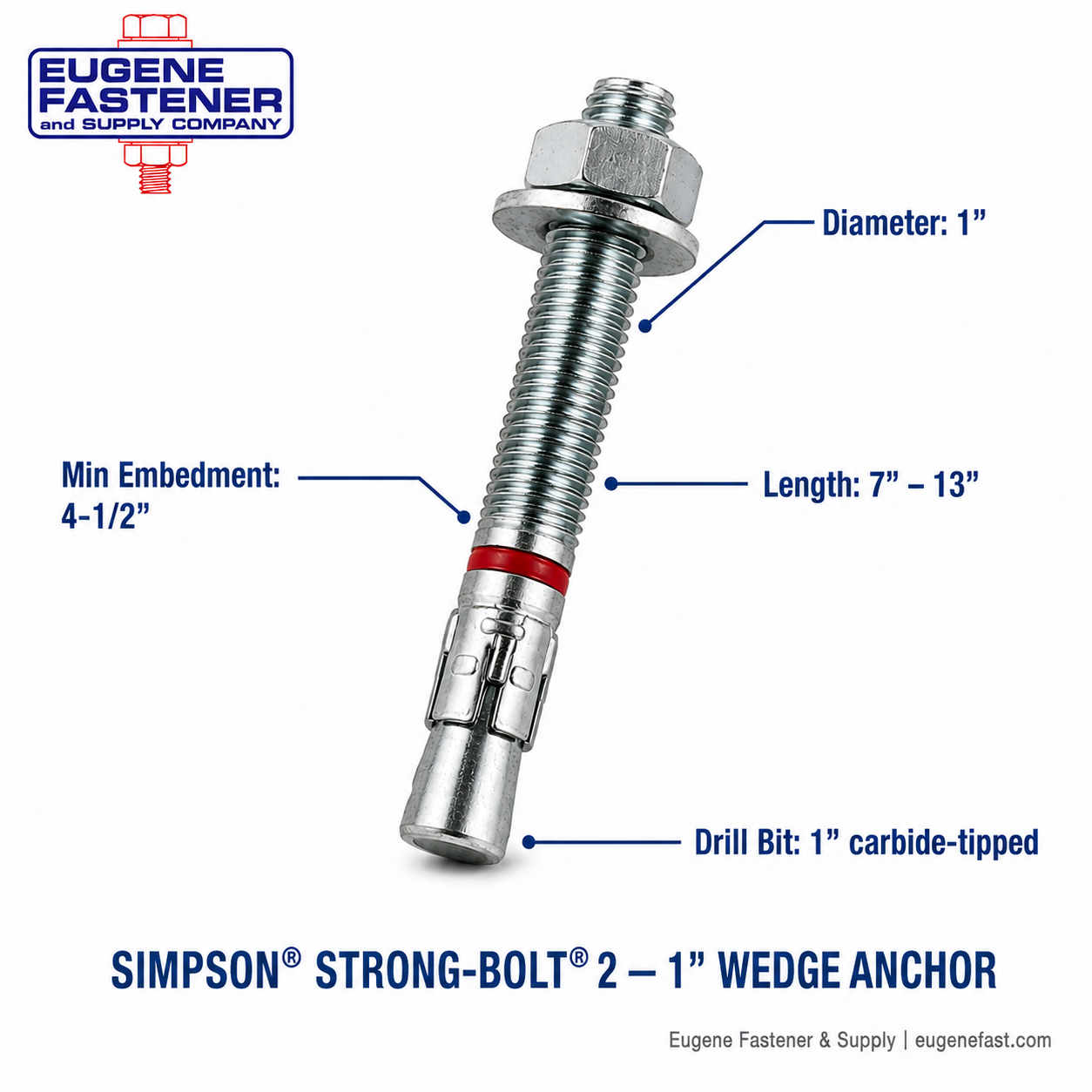
- SIMSTB2-1001000
- 1" X 10" SIMPSON STRONG-BOLT 2 WEDGE ANCHOR CS ZINC
- F
- 0
- Weight: 2.5300000
| Brand: | Simpson Strong-TieSimpson Strong-Tie |
| Diameter: | 11 |
| Length: | 1010 |
| Drill Size: | 11 |
| Finish: | Zinc PlatedZinc Plated |
| Material: | Carbon SteelCarbon Steel |
| Part Number: | SIMSTB2-1001000SIMSTB2-1001000 |
- SIMSTB2-100700
- 1" X 7" SIMPSON STRONG-BOLT 2 WEDGE ANCHOR CS ZINC
- F
- 0
- Weight: 1.7820000
| Brand: | Simpson Strong-TieSimpson Strong-Tie |
| Diameter: | 11 |
| Length: | 77 |
| Drill Size: | 11 |
| Finish: | Zinc PlatedZinc Plated |
| Material: | Carbon SteelCarbon Steel |
| Part Number: | SIMSTB2-100700SIMSTB2-100700 |
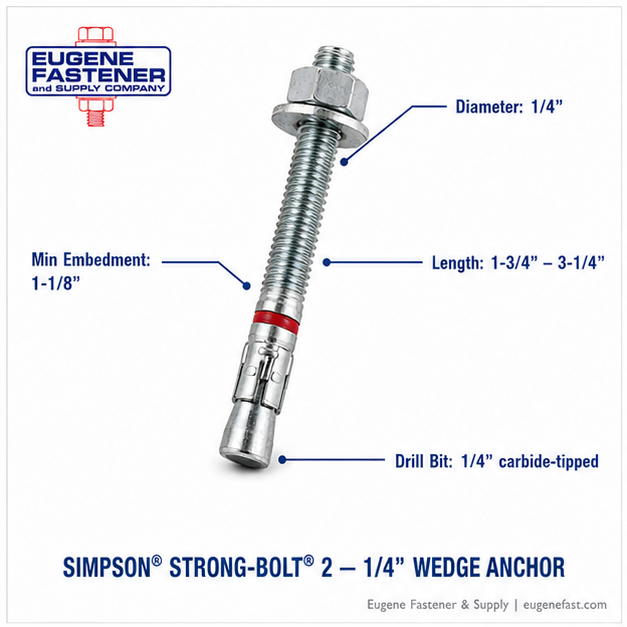
- SIMSTB2-25134
- 1/4" X 1-3/4" SIMPSON STRONG-BOLT 2 WEDGE ANCHOR CS ZINC
- D
- 0
- Weight: 0.0400000
| Brand: | Simpson Strong-TieSimpson Strong-Tie |
| Diameter: | 1/41/4 |
| Length: | 1-3/41-3/4 |
| Drill Size: | 1/41/4 |
| Finish: | Zinc PlatedZinc Plated |
| Material: | Carbon SteelCarbon Steel |
| Part Number: | SIMSTB2-25134SIMSTB2-25134 |
- SIMSTB2-25214
- 1/4" X 2-1/4" SIMPSON STRONG-BOLT 2 WEDGE ANCHOR CS ZINC
- E
- 0
- Weight: 0.0500000
| Brand: | Simpson Strong-TieSimpson Strong-Tie |
| Diameter: | 1/41/4 |
| Length: | 2-1/42-1/4 |
| Drill Size: | 1/41/4 |
| Finish: | Zinc PlatedZinc Plated |
| Material: | Carbon SteelCarbon Steel |
| Part Number: | SIMSTB2-25214SIMSTB2-25214 |
- SIMSTB2-25314
- 1/4" X 3-1/4" SIMPSON STRONG-BOLT 2 WEDGE ANCHOR CS ZINC
- D
- 0
- Weight: 0.0600000
| Brand: | Simpson Strong-TieSimpson Strong-Tie |
| Diameter: | 1/41/4 |
| Length: | 3-1/43-1/4 |
| Drill Size: | 1/41/4 |
| Finish: | Zinc PlatedZinc Plated |
| Material: | Carbon SteelCarbon Steel |
| Part Number: | SIMSTB2-25314SIMSTB2-25314 |
- SIMSTB2-253144SS
- 1/4" X 3-1/4" SIMPSON STRONG-BOLT 2 WEDGE ANCHOR 304SS
- F
- 0
- Weight: 0.0600000
| Brand: | Simpson Strong-TieSimpson Strong-Tie |
| Diameter: | 1/41/4 |
| Length: | 3-1/43-1/4 |
| Drill Size: | 1/41/4 |
| Finish: | Type 304 StainlessType 304 Stainless |
| Material: | Type 304 Stainless SteelType 304 Stainless Steel |
| Part Number: | SIMSTB2-253144SSSIMSTB2-253144SS |
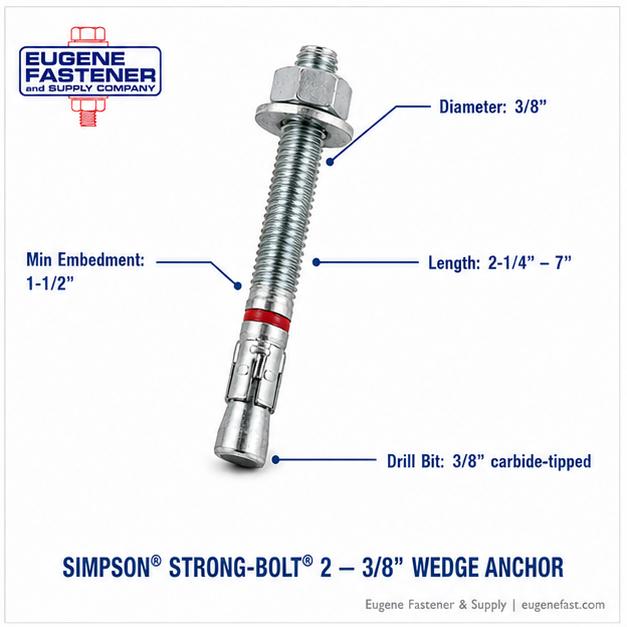
- SIMSTB2-37234
- 3/8" X 2-3/4" SIMPSON STRONG-BOLT 2 WEDGE ANCHOR CS ZINC
- D
- 0
- Weight: 0.1100000
| Brand: | Simpson Strong-TieSimpson Strong-Tie |
| Diameter: | 3/83/8 |
| Length: | 2-3/42-3/4 |
| Drill Size: | 3/83/8 |
| Finish: | Zinc PlatedZinc Plated |
| Material: | Carbon SteelCarbon Steel |
| Part Number: | SIMSTB2-37234SIMSTB2-37234 |
- SIMSTB2-373004SS
- 3/8" X 3" SIMPSON STRONG-BOLT 2 WEDGE ANCHOR 304SS
- F
- 0
- Weight: 0.1200000
| Brand: | Simpson Strong-TieSimpson Strong-Tie |
| Diameter: | 3/83/8 |
| Length: | 33 |
| Drill Size: | 3/83/8 |
| Finish: | Type 304 StainlessType 304 Stainless |
| Material: | Type 304 Stainless SteelType 304 Stainless Steel |
| Part Number: | SIMSTB2-373004SSSIMSTB2-373004SS |
- SIMSTB2-37300F50
- 3/8" X 3" SIMPSON STRONG-BOLT 2 WEDGE ANCHOR CS ZINC
- D
- 0
- Weight: 0.1200000
| Brand: | Simpson Strong-TieSimpson Strong-Tie |
| Diameter: | 3/83/8 |
| Length: | 33 |
| Drill Size: | 3/83/8 |
| Finish: | Zinc PlatedZinc Plated |
| Material: | Carbon SteelCarbon Steel |
| Part Number: | SIMSTB2-37300F50SIMSTB2-37300F50 |
- SIMSTB2-37334
- 3/8" X 3-3/4" SIMPSON STRONG-BOLT 2 WEDGE ANCHOR CS ZINC
- D
- 0
- Weight: 0.1400000
| Brand: | Simpson Strong-TieSimpson Strong-Tie |
| Diameter: | 3/83/8 |
| Length: | 3-3/43-3/4 |
| Drill Size: | 3/83/8 |
| Finish: | Zinc PlatedZinc Plated |
| Material: | Carbon SteelCarbon Steel |
| Part Number: | SIMSTB2-37334SIMSTB2-37334 |
- SIMSTB2-37500
- 3/8" X 5" SIMPSON STRONG-BOLT 2 WEDGE ANCHOR CS ZINC
- E
- 0
- Weight: 0.1800000
| Brand: | Simpson Strong-TieSimpson Strong-Tie |
| Diameter: | 3/83/8 |
| Length: | 55 |
| Drill Size: | 3/83/8 |
| Finish: | Zinc PlatedZinc Plated |
| Material: | Carbon SteelCarbon Steel |
| Part Number: | SIMSTB2-37500SIMSTB2-37500 |
- SIMSTB2-37700
- 3/8" X 7" SIMPSON STRONG-BOLT 2 WEDGE ANCHOR CS ZINC
- D
- 0
- Weight: 0.2000000
| Brand: | Simpson Strong-TieSimpson Strong-Tie |
| Diameter: | 3/83/8 |
| Length: | 77 |
| Drill Size: | 3/83/8 |
| Finish: | Zinc PlatedZinc Plated |
| Material: | Carbon SteelCarbon Steel |
| Part Number: | SIMSTB2-37700SIMSTB2-37700 |
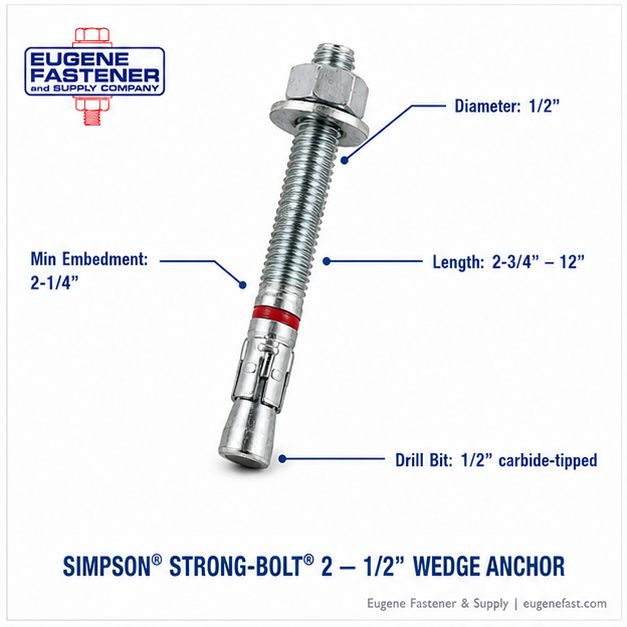
- SIMSTB2-50100
- 1/2" X 10" SIMPSON STRONG-BOLT 2 WEDGE ANCHOR CS ZINC
- F
- 0
- Weight: 0.5200000
| Brand: | Simpson Strong-TieSimpson Strong-Tie |
| Diameter: | 1/21/2 |
| Length: | 1010 |
| Drill Size: | 1/21/2 |
| Finish: | Zinc PlatedZinc Plated |
| Material: | Carbon SteelCarbon Steel |
| Part Number: | SIMSTB2-50100SIMSTB2-50100 |
- SIMSTB2-50234R25
- 1/2" X 2-3/4" SIMPSON STRONG-BOLT 2 WEDGE ANCHOR CS ZINC
- F
- 0
- Weight: 0.1944000
| Brand: | Simpson Strong-TieSimpson Strong-Tie |
| Diameter: | 1/21/2 |
| Length: | 3-3/43-3/4 |
| Drill Size: | 1/21/2 |
| Finish: | Zinc PlatedZinc Plated |
| Material: | Carbon SteelCarbon Steel |
| Part Number: | SIMSTB2-50334SIMSTB2-50334 |
- SIMSTB2-50334
- 1/2" X 3-3/4" SIMPSON STRONG-BOLT 2 WEDGE ANCHOR CS ZINC
- E
- 0
- Weight: 0.2300000
| Brand: | Simpson Strong-TieSimpson Strong-Tie |
| Diameter: | 1/21/2 |
| Length: | 3-3/43-3/4 |
| Drill Size: | 1/21/2 |
| Finish: | Zinc PlatedZinc Plated |
| Material: | Carbon SteelCarbon Steel |
| Part Number: | SIMSTB2-50334SIMSTB2-50334 |
- SIMSTB2-503344SS
- 1/2" X 3-3/4" SIMPSON STRONG-BOLT 2 WEDGE ANCHOR 304SS
- F
- 0
- Weight: 0.2300000
| Brand: | Simpson Strong-TieSimpson Strong-Tie |
| Diameter: | 1/21/2 |
| Length: | 3-3/43-3/4 |
| Drill Size: | 1/21/2 |
| Finish: | Type 304 StainlessType 304 Stainless |
| Material: | Type 304 Stainless SteelType 304 Stainless Steel |
| Part Number: | SIMSTB2-503344SSSIMSTB2-503344SS |
- SIMSTB2-504144SS
- 1/2" X 4-1/4" SIMPSON STRONG-BOLT 2 WEDGE ANCHOR 304SS
- F
- 0
- Weight: 0.2400000
| Brand: | Simpson Strong-TieSimpson Strong-Tie |
| Diameter: | 1/21/2 |
| Length: | 4-1/44-1/4 |
| Drill Size: | 1/21/2 |
| Finish: | Type 304 StainlessType 304 Stainless |
| Material: | Type 304 Stainless SteelType 304 Stainless Steel |
| Part Number: | SIMSTB2-504144SSSIMSTB2-504144SS |
- SIMSTB2-50434
- 1/2" X 4-3/4" SIMPSON STRONG-BOLT 2 WEDGE ANCHOR CS ZINC
- D
- 0
- Weight: 0.2680000
| Brand: | Simpson Strong-TieSimpson Strong-Tie |
| Diameter: | 1/21/2 |
| Length: | 4-3/44-3/4 |
| Drill Size: | 1/21/2 |
| Finish: | Zinc PlatedZinc Plated |
| Material: | Carbon SteelCarbon Steel |
| Part Number: | SIMSTB2-50434SIMSTB2-50434 |
- SIMSTB2-50512
- 1/2" X 5-1/2" SIMPSON STRONG-BOLT 2 WEDGE ANCHOR CS ZINC
- D
- 0
- Weight: 0.3100000
| Brand: | Simpson Strong-TieSimpson Strong-Tie |
| Diameter: | 1/21/2 |
| Length: | 5-1/25-1/2 |
| Drill Size: | 1/21/2 |
| Finish: | Zinc PlatedZinc Plated |
| Material: | Carbon SteelCarbon Steel |
| Part Number: | SIMSTB2-50512SIMSTB2-50512 |
- SIMSTB2-505124SS
- 1/2" X 5-1/2" SIMPSON STRONG-BOLT 2 WEDGE ANCHOR 304SS
- F
- 0
- Weight: 0.3100000
| Brand: | Simpson Strong-TieSimpson Strong-Tie |
| Diameter: | 1/21/2 |
| Length: | 5-1/25-1/2 |
| Drill Size: | 1/21/2 |
| Finish: | Type 304 StainlessType 304 Stainless |
| Material: | Type 304 Stainless SteelType 304 Stainless Steel |
| Part Number: | SIMSTB2-505124SSSIMSTB2-505124SS |
- SIMSTB2-50700
- 1/2" X 7" SIMPSON STRONG-BOLT 2 WEDGE ANCHOR CS ZINC
- F
- 0
- Weight: 0.3700000
| Brand: | Simpson Strong-TieSimpson Strong-Tie |
| Diameter: | 1/21/2 |
| Length: | 77 |
| Drill Size: | 1/21/2 |
| Finish: | Zinc PlatedZinc Plated |
| Material: | Carbon SteelCarbon Steel |
| Part Number: | SIMSTB2-50700SIMSTB2-50700 |
- SIMSTB2-50812
- 1/2" X 8-1/2" SIMPSON STRONG-BOLT 2 WEDGE ANCHOR CS ZINC
- F
- 0
- Weight: 0.4500000
| Brand: | Simpson Strong-TieSimpson Strong-Tie |
| Diameter: | 1/21/2 |
| Length: | 8-1/28-1/2 |
| Drill Size: | 1/21/2 |
| Finish: | Zinc PlatedZinc Plated |
| Material: | Carbon SteelCarbon Steel |
| Part Number: | SIMSTB2-50812SIMSTB2-50812 |
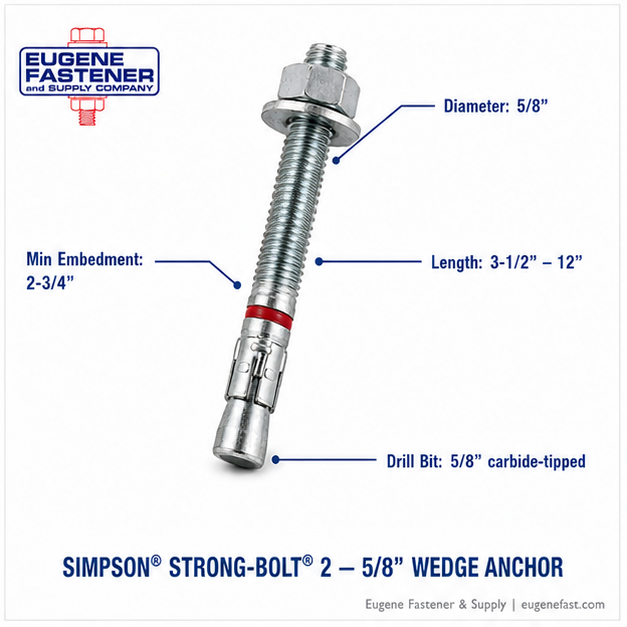
- SIMSTB2-62100
- 5/8" X 10" SIMPSON STRONG-BOLT 2 WEDGE ANCHOR CS ZINC
- F
- 0
- Weight: 0.8500000
| Brand: | Simpson Strong-TieSimpson Strong-Tie |
| Diameter: | 5/85/8 |
| Length: | 1010 |
| Drill Size: | 5/85/8 |
| Finish: | Zinc PlatedZinc Plated |
| Material: | Carbon SteelCarbon Steel |
| Part Number: | SIMSTB2-62100SIMSTB2-62100 |
- SIMSTB2-62312R20
- 5/8" X 3-1/2" SIMPSON STRONG-BOLT 2 WEDGE ANCHOR CS ZINC
- F
- 0
- Weight: 0.4000000
| Brand: | Simpson Strong-TieSimpson Strong-Tie |
| Diameter: | 5/85/8 |
| Length: | 3-1/23-1/2 |
| Drill Size: | 5/85/8 |
| Finish: | Zinc PlatedZinc Plated |
| Material: | Carbon SteelCarbon Steel |
| Part Number: | SIMSTB2-62312R20SIMSTB2-62312R20 |
- SIMSTB2-62412
- 5/8" X 4-1/2" SIMPSON STRONG-BOLT 2 WEDGE ANCHOR CS ZINC
- F
- 0
- Weight: 0.4300000
| Brand: | Simpson Strong-TieSimpson Strong-Tie |
| Diameter: | 5/85/8 |
| Length: | 4-1/24-1/2 |
| Drill Size: | 5/85/8 |
| Finish: | Zinc PlatedZinc Plated |
| Material: | Carbon SteelCarbon Steel |
| Part Number: | SIMSTB2-62412SIMSTB2-62412 |
- SIMSTB2-62500
- 5/8" X 5" SIMPSON STRONG-BOLT 2 WEDGE ANCHOR CS ZINC
- E
- 0
- Weight: 0.4700000
| Brand: | Simpson Strong-TieSimpson Strong-Tie |
| Diameter: | 5/85/8 |
| Length: | 55 |
| Drill Size: | 5/85/8 |
| Finish: | Zinc PlatedZinc Plated |
| Material: | Carbon SteelCarbon Steel |
| Part Number: | SIMSTB2-62500SIMSTB2-62500 |
- SIMSTB2-62600
- 5/8" X 6" SIMPSON STRONG-BOLT 2 WEDGE ANCHOR CS ZINC
- E
- 0
- Weight: 0.5400000
| Brand: | Simpson Strong-TieSimpson Strong-Tie |
| Diameter: | 5/85/8 |
| Length: | 66 |
| Drill Size: | 5/85/8 |
| Finish: | Zinc PlatedZinc Plated |
| Material: | Carbon SteelCarbon Steel |
| Part Number: | SIMSTB2-62600SIMSTB2-62600 |
- SIMSTB2-62700
- 5/8" X 7" SIMPSON STRONG-BOLT 2 WEDGE ANCHOR CS ZINC
- F
- 0
- Weight: 0.6000000
| Brand: | Simpson Strong-TieSimpson Strong-Tie |
| Diameter: | 5/85/8 |
| Length: | 77 |
| Drill Size: | 5/85/8 |
| Finish: | Zinc PlatedZinc Plated |
| Material: | Carbon SteelCarbon Steel |
| Part Number: | SIMSTB2-62700SIMSTB2-62700 |
- SIMSTB2-62812
- 5/8" X 8-1/2" SIMPSON STRONG-BOLT 2 WEDGE ANCHOR CS ZINC
- F
- 0
- Weight: 0.7200000
| Brand: | Simpson Strong-TieSimpson Strong-Tie |
| Diameter: | 5/85/8 |
| Length: | 8-1/28-1/2 |
| Drill Size: | 5/85/8 |
| Finish: | Zinc PlatedZinc Plated |
| Material: | Carbon SteelCarbon Steel |
| Part Number: | SIMSTB2-62812SIMSTB2-62812 |
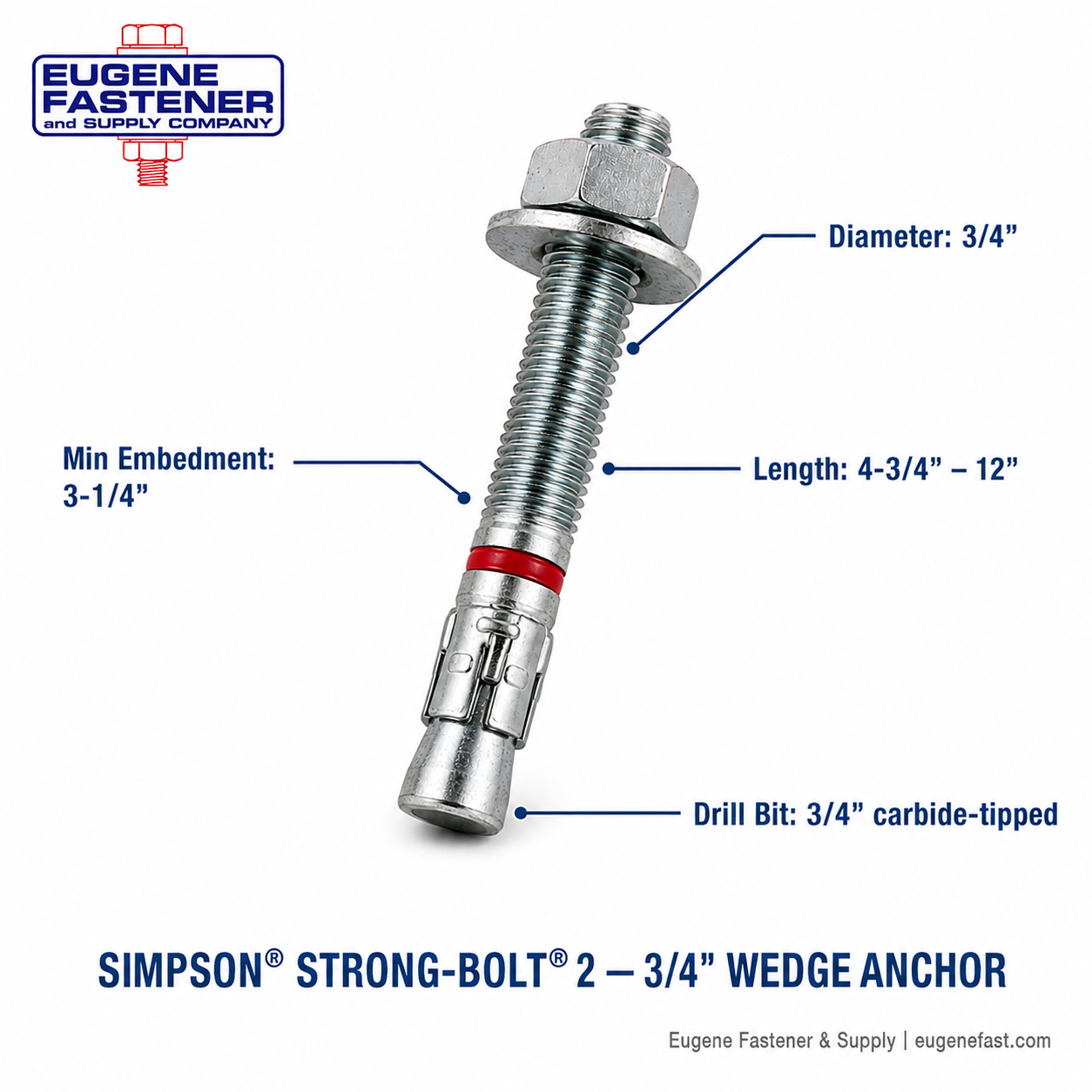
- SIMSTB2-75100
- 3/4" X 10" SIMPSON STRONG-BOLT 2 WEDGE ANCHOR CS ZINC
- F
- 0
- Weight: 1.2300000
| Brand: | Simpson Strong-TieSimpson Strong-Tie |
| Diameter: | 3/43/4 |
| Length: | 1010 |
| Drill Size: | 3/43/4 |
| Finish: | Zinc PlatedZinc Plated |
| Material: | Carbon SteelCarbon Steel |
| Part Number: | SIMSTB2-75100SIMSTB2-75100 |
- SIMSTB2-75434
- 3/4" X 4-3/4" SIMPSON STRONG-BOLT 2 WEDGE ANCHOR CS ZINC
- F
- 0
- Weight: 0.8000000
| Brand: | Simpson Strong-TieSimpson Strong-Tie |
| Diameter: | 3/43/4 |
| Length: | 4-3/44-3/4 |
| Drill Size: | 3/43/4 |
| Finish: | Zinc PlatedZinc Plated |
| Material: | Carbon SteelCarbon Steel |
| Part Number: | SIMSTB2-75434SIMSTB2-75434 |
- SIMSTB2-75512
- 3/4" X 5-1/2" SIMPSON STRONG-BOLT 2 WEDGE ANCHOR CS ZINC
- F
- 0
- Weight: 0.8000000
| Brand: | Simpson Strong-TieSimpson Strong-Tie |
| Diameter: | 3/43/4 |
| Length: | 5-1/25-1/2 |
| Drill Size: | 3/43/4 |
| Finish: | Zinc PlatedZinc Plated |
| Material: | Carbon SteelCarbon Steel |
| Part Number: | SIMSTB2-75512SIMSTB2-75512 |
- SIMSTB2-75614
- 3/4" X 6-1/4" SIMPSON STRONG-BOLT 2 WEDGE ANCHOR CS ZINC
- D
- 0
- Weight: 0.8400000
| Brand: | Simpson Strong-TieSimpson Strong-Tie |
| Diameter: | 3/43/4 |
| Length: | 6-1/46-1/4 |
| Drill Size: | 3/43/4 |
| Finish: | Zinc PlatedZinc Plated |
| Material: | Carbon SteelCarbon Steel |
| Part Number: | SIMSTB2-75614SIMSTB2-75614 |
- SIMSTB2-75700
- 3/4" X 7" SIMPSON STRONG-BOLT 2 WEDGE ANCHOR CS ZINC
- F
- 0
- Weight: 0.9100000
| Brand: | Simpson Strong-TieSimpson Strong-Tie |
| Diameter: | 3/43/4 |
| Length: | 77 |
| Drill Size: | 3/43/4 |
| Finish: | Zinc PlatedZinc Plated |
| Material: | Carbon SteelCarbon Steel |
| Part Number: | SIMSTB2-75700SIMSTB2-75700 |
- SIMSTB2-75812
- 3/4" X 8-1/2" SIMPSON STRONG-BOLT 2 WEDGE ANCHOR CS ZINC
- F
- 0
- Weight: 1.0700000
| Brand: | Simpson Strong-TieSimpson Strong-Tie |
| Diameter: | 3/43/4 |
| Length: | 8-1/28-1/2 |
| Drill Size: | 3/43/4 |
| Finish: | Zinc PlatedZinc Plated |
| Material: | Carbon SteelCarbon Steel |
| Part Number: | SIMSTB2-75812SIMSTB2-75812 |
- SIMSTB2-758126SS
- 3/4" X 8-1/2" SIMPSON STRONG-BOLT 2 WEDGE ANCHOR 316SS
- F
- 0
- Weight: 1.2000000
| Brand: | Simpson Strong-TieSimpson Strong-Tie |
| Diameter: | 3/43/4 |
| Length: | 8-1/28-1/2 |
| Drill Size: | 3/43/4 |
| Finish: | Type 316 StainlessType 316 Stainless |
| Material: | Type 316 Stainless SteelType 316 Stainless Steel |
| Part Number: | SIMSTB2-758126SSSIMSTB2-758126SS |
No items match your selected filters. Please change or reset your filters to try again.
Wedge Anchors for Concrete — Simpson Strong-Bolt 2 in Stock
Need wedge anchors for a structural job, equipment install, or volume order?
Get Job Pricing / Submittals Email Sales
Include diameter, length, finish, and quantity for fastest quoting. ICC-ES ESR-3037 submittal package available on request.
Free Downloads — Printable Reference PDFs
Tools, 6-step installation, common mistakes, edge-distance guidelines. Print for the job site.
Per-diameter tension and shear load values, edge distance, code listings, embedment depths. Drop into project submittals.
Pick the right finish for your environment. Zinc, mechanically galvanized, 304, and 316 stainless compared.
How a Wedge Anchor Works
A wedge anchor is a mechanical expansion anchor designed for solid concrete. The body is a threaded bolt with a tapered cone at the bottom and a separate expansion clip (the “wedge”) seated above the cone. You drill a hole the same diameter as the anchor body, drop the anchor through the fixture into the hole, and tighten the nut. As the nut tightens, the bolt is pulled upward while the clip stays in place — the cone is forced through the clip, which expands hard against the inside walls of the drilled hole. The result is a permanent friction-and-mechanical-interlock connection that’s rated for tension and shear loads.
Because the holding force depends on hole-wall friction, wedge anchors are designed for solid concrete only. They are not suitable for hollow block, brick, or mortar joints. For hollow base materials, see our screw anchors or wedge vs sleeve anchor comparison.
Simpson Strong-Bolt 2 — The Code-Approved Wedge Anchor We Stock
The Simpson Strong-Tie Strong-Bolt 2 (STB2) is our primary stocked wedge anchor line. It carries ICC-ES ESR-3037 code approval for both cracked and uncracked concrete and is qualified for seismic design categories A through F. The dual undercutting embossment on the expansion clip provides higher load values than older single-cut wedge anchor designs, making it suitable for the most demanding structural and mechanical applications.
- Code approval: ICC-ES ESR-3037 (concrete), City of LA Supplement, Florida FL15730, UL Listed
- Seismic qualified: Categories A through F per ACI 355.2 and AC193
- Diameters stocked: 1/4", 3/8", 1/2", 5/8", 3/4", 1"
- Lengths: 1-3/4" through 13" depending on diameter
- Finishes: Carbon steel zinc plated, Type 304 stainless, Type 316 stainless, mechanically galvanized
Wedge Anchor Sizes & Installation Data
The table below shows the key installation specifications for each Strong-Bolt 2 diameter. Drill bit size for a wedge anchor matches the anchor body diameter exactly — no oversizing, no undersizing.
| Anchor Diameter | Drill Bit | Min. Embedment | Min. Hole Depth | Install Torque | Min. Concrete Thickness |
|---|---|---|---|---|---|
| 1/4" | 1/4" | 1-1/8" | 1-1/2" | 4 ft-lbf | 3-1/4" |
| 3/8" | 3/8" | 1-1/2" | 2" | 30 ft-lbf | 3-1/4" |
| 1/2" | 1/2" | 2-1/4" | 2-3/4" | 60 ft-lbf | 4" |
| 5/8" | 5/8" | 2-3/4" | 3-1/4" | 90 ft-lbf | 5-1/2" |
| 3/4" | 3/4" | 3-1/4" | 3-3/4" | 150 ft-lbf | 6" |
| 1" | 1" | 4-1/2" | 5" | 230 ft-lbf | 9" |
Values per Simpson Strong-Tie Strong-Bolt 2 published installation data (catalog C-A-2023). For full per-SKU specifications including tension and shear capacity, see Simpson’s ESR-3037 evaluation report or contact our team for the application-specific data sheet.
Materials & Finishes — When to Use Each
| Finish | Best For | Trade-Offs |
|---|---|---|
| Carbon Steel, Yellow Zinc Plated | Interior and dry exterior applications — the default choice for most structural and equipment-mounting jobs | Will corrode in marine, pool, or persistently wet environments; not for long-term outdoor exposure where appearance matters |
| Mechanically Galvanized (MG) | Exterior applications where higher corrosion resistance than zinc is needed but stainless cost is not justified — hot-dip-style protection | Heavier coating may slightly affect installation torque; not as corrosion-resistant as 316 stainless in marine |
| Type 304 Stainless Steel (4SS) | Coastal exterior, food processing, washdown environments, anchoring stainless equipment, applications where cosmetic appearance matters long term | Higher cost than zinc; not for direct submersion or chloride-heavy environments |
| Type 316 Stainless Steel (6SS) | Marine and chloride-exposed installations — piers, splash zones, pool decks, chemical processing, coastal industrial | Highest cost; lower load values than carbon steel of the same diameter |
Wedge Anchor vs Sleeve Anchor vs Screw Anchor — Which Do I Need?
Three of the most common concrete anchors solve different problems. The right choice depends on what you’re anchoring into and what loads it has to carry.
| Anchor Type | Best For | Substrate | Removable? |
|---|---|---|---|
| Wedge Anchor | High-load structural, equipment, code-required installs | Solid concrete only | No (permanent) |
| Sleeve Anchor | Medium-load handrails, electrical, light equipment in mixed substrates | Concrete, brick, hollow block | No (permanent) |
| Screw Anchor (Titen / Tapcon) | Light- to medium-load, removable connections, temporary installations | Concrete, masonry | Yes (removable, reusable) |
For a deeper comparison with applications and load examples, see our wedge anchor vs sleeve anchor guide.
Choosing the Right Wedge Anchor
Four decisions: diameter, length, finish, and load category.
Diameter
Match the diameter to the load class. As a starting point:
- 1/4" to 3/8" — light duty: electrical panels, conduit straps, small brackets, cable tray
- 1/2" to 5/8" — medium duty: handrails, equipment pads, HVAC, ledger plates, racking systems
- 3/4" to 1" — heavy duty: structural base plates, crane rails, seismic bracing, heavy-equipment mounting
Length
The required length is the fixture thickness + minimum embedment depth + enough thread for the nut and washer above the surface. Embedment is published per diameter in the table above. A common rule of thumb is 4 to 6 anchor diameters of embedment, with deeper embedment giving higher load capacity. Always verify against the manufacturer’s published depth before specifying.
Finish
See the materials table above. Most interior structural and equipment work is yellow zinc; exterior dry is mechanically galvanized; coastal and washdown is 304 stainless; marine and chemical is 316 stainless.
Load Category
Code-required installs (structural, seismic, life-safety) need an anchor with current ICC-ES code approval — the Simpson Strong-Bolt 2 carries ESR-3037 and qualifies for seismic categories A through F. Non-structural utility anchoring (light brackets, conduit straps) does not require code-listed anchors but the published load values still apply.
Wedge Anchor Installation — Step-by-Step Summary
- Drill the hole using a carbide-tipped SDS or hammer drill bit matching the anchor diameter exactly. Drill at least to the minimum hole depth in the table above — deeper is fine, shallower is not.
- Clean the hole by blowing out drilled dust with compressed air or a blow-out pump. Dust in the hole reduces holding power.
- Drop the anchor through the fixture and into the hole until the nut and washer rest against the fixture surface. The wedge clip sits at the bottom of the hole.
- Tighten the nut to the specified install torque using a torque wrench. The bolt is pulled upward through the wedge clip, expanding it against the hole wall. Do not over-torque — that can fracture the concrete around the anchor.
- Verify the install by checking that the fixture is firmly seated, no gap exists between fixture and concrete, and the nut sits on a clean threaded section above the fixture.
For the full installation walk-through with common mistakes and verification tips, see our wedge anchor selection and installation guide.
Common Applications
- Structural steel: base plates for columns and beams, ledger angle bolts, seismic bracing connections
- Equipment mounting: machinery to shop floors, HVAC equipment pads, generator skids, compressors
- Safety & access: handrails and guardrails, fall-arrest anchors, safety bollards, gate posts
- Building utilities: pipe supports, conduit and cable tray hangers, fire sprinkler runs, electrical panels
- Concrete construction: sill plate fastening, ledger boards, embed plate retrofits, tilt-up panel connections
- Site work: bollards, pole bases, sign posts, equipment guards, traffic barriers
Frequently Asked Questions About Wedge Anchors
What is the difference between a wedge anchor and a sleeve anchor?
A wedge anchor uses a small expansion clip (wedge) at the base of a threaded bolt. It produces a high-strength, code-rated anchor in solid concrete only. A sleeve anchor uses a long expansion sleeve that runs most of the bolt’s length, distributing the expansion force over a larger area. Sleeve anchors work in concrete, brick, and hollow block and are easier to install in marginal substrates, but they have lower published load values than wedge anchors at the same diameter. Use a wedge anchor for high-load structural work in solid concrete; use a sleeve anchor for medium-load mixed-substrate work. Detailed comparison: wedge vs sleeve anchor guide.
What size drill bit do I use for a wedge anchor?
The drill bit diameter for a wedge anchor matches the anchor diameter exactly. A 1/2" wedge anchor needs a 1/2" carbide-tipped concrete drill bit. Do not undersize (anchor will not seat) or oversize (clip will not expand against the hole wall). Use the chart above for the full size matrix or see our concrete anchor drill bit chart.
How deep do I drill the hole for a wedge anchor?
Drill the hole at least 1/4" deeper than the anchor’s minimum embedment depth, with no maximum. The minimum embedment varies by anchor diameter (see the installation data table above). For example, a 1/2" Strong-Bolt 2 needs 2-1/4" minimum embedment, so drill the hole at least 2-3/4" deep. Deeper holes are fine and give higher load capacity; shallower holes will not allow the anchor to seat correctly.
Can I use a wedge anchor in brick or block?
No. Wedge anchors are designed for solid concrete only. The expansion clip relies on solid base material to develop holding force; in hollow block, brick, or mortar joints, the clip can break out the base material rather than expand against it. For brick or hollow block, use a concrete screw anchor or sleeve anchor instead.
How much weight will a wedge anchor hold?
Holding capacity depends on diameter, embedment depth, concrete strength, and whether the concrete is cracked or uncracked. As a rough order of magnitude for the Simpson Strong-Bolt 2 in 4000 psi uncracked concrete: a 1/2" anchor at 3-1/4" embedment carries roughly 4,500 lbf in tension; a 5/8" at 3-1/2" embedment carries roughly 6,500 lbf; a 3/4" at 4-3/4" embedment carries roughly 9,500 lbf. These are catalog values for design reference only and do not include code-required reduction factors. For application-qualified design loads, request the ESR-3037 evaluation report or contact our team.
Can I remove and reuse a wedge anchor?
No. Wedge anchors are permanent. Once the wedge clip has expanded against the hole wall, the anchor cannot be removed in the same condition it went in. If a wedge anchor needs to come out, the standard methods are to cut the bolt off flush with the concrete surface or grind down past the surface and patch over. If you need a removable anchor, use a concrete screw anchor (Titen HD or Tapcon) instead.
What torque do I tighten a wedge anchor to?
Use the manufacturer’s published install torque for the diameter (see table above). For Simpson Strong-Bolt 2: 4 ft-lbf at 1/4", 30 ft-lbf at 3/8", 60 ft-lbf at 1/2", 90 ft-lbf at 5/8", 150 ft-lbf at 3/4", 230 ft-lbf at 1". Use a calibrated torque wrench. Over-torquing can fracture concrete around the anchor or strip threads; under-torquing leaves the anchor partially set with reduced holding capacity.
Are Simpson Strong-Bolt 2 anchors code approved?
Yes. The Strong-Bolt 2 carries ICC-ES ESR-3037 for cracked and uncracked concrete, City of Los Angeles supplement within ESR-3037, Florida FL15730, and UL listing. It is qualified for seismic design categories A through F and meets ACI 355.2 and AC193 requirements. Both the carbon steel and stainless versions are code-listed.
What is the difference between 304 and 316 stainless wedge anchors?
Both are austenitic stainless steels. Type 304 (suffix 4SS in our SKUs) is general corrosion resistant and works for most outdoor and washdown installations. Type 316 (suffix 6SS) adds molybdenum for chloride resistance, making it the right choice for marine and pool environments where 304 would eventually pit. Use 316 within roughly five miles of saltwater, in pool decks and splash zones, in chemical processing, or wherever chloride exposure is persistent. Use 304 for general exterior, food processing, and architectural applications.
Do I need a special drill for concrete wedge anchors?
You need a hammer drill or rotary hammer (SDS) drill capable of percussive action through the concrete. A regular twist drill in a regular drill will not penetrate concrete in any reasonable time and will not produce a clean hole. The drill bit must be carbide-tipped and rated for concrete — not an HSS bit. SDS-Plus shanks fit most rotary hammers; SDS-Max is used for larger 3/4" and 1" bits.
Can wedge anchors be installed in the ceiling (overhead)?
Yes, but the design must account for sustained tension load and any vibration. The Simpson Strong-Bolt 2 is qualified for overhead installations under ESR-3037 with specific reductions for sustained tension. For overhead anchors carrying life-safety loads (sprinkler heads, pipe supports above occupied areas, fall arrest), the install must be inspected and the anchor must carry the appropriate code listing for the application. Contact our team for the overhead-installation submittal package.
What is the dagger symbol next to some wedge anchor part numbers?
Simpson uses a dagger footnote (†) on certain short-length variants to indicate that the anchor does not meet the minimum embedment depth published in the ESR-3037 code report. These short anchors are still sellable and useful for non-code utility applications (light brackets, signage, accessories) but should not be specified for structural, seismic, or code-required installs. The longer length in the same diameter is the code-compliant option.
Do you stock wedge anchors in metric sizes?
The Simpson Strong-Bolt 2 line we stock is fractional inch only. If you need metric wedge anchors (M6, M8, M10, M12), contact our team and we’ll source them from our distributor partners. Most metric anchor specifications can be matched closely with a fractional equivalent — for example, M12 is very close to 1/2" and is often a direct substitute in non-critical applications.
Why Buy Wedge Anchors From Eugene Fastener?
We have stocked Simpson Strong-Tie products since the line became the contractor and engineer’s default choice for code-rated concrete anchoring, and the Strong-Bolt 2 is a daily-pick item from our shelves. Contractors, engineers, and maintenance buyers across the Pacific Northwest order from us because we keep the full diameter and length range in stock, ship same day on orders before 2pm Pacific, and have the technical depth on staff to help you spec the right anchor when the job has unusual constraints — corrosive environment, seismic category, overhead loading, marginal concrete strength, edge-distance limits.
If you need job pricing, submittal documents (ESR-3037, install instructions, ICC reports), or a Strong-Bolt 2 alternative for a budget-sensitive project, contact our team and we’ll get it done. Will-call pickup at our Eugene, Oregon warehouse is available for local contractors.
Helpful Guides
Other Concrete Anchors at Eugene Fastener: concrete screw anchors, foundation anchor bolts, hammer drive anchors, toggle bolts, and the full anchor bolts and concrete anchors category.
Stocking Simpson Strong-Tie since 1965. Family owned. Eugene, Oregon.
View Cart
View Wishlist