
Rivet Nut Selection Guide
Choosing the right rivet nut means making four decisions: which series (IKF or ISR), which material (steel, aluminum, or stainless), which thread size, and which grip range. Get any one wrong and the rivet nut won’t set properly, will spin under torque, or will corrode prematurely. This guide walks through each decision in order so you end up with the right rivet nut for your application.
Step 1: Choose Your Series — IKF vs ISR
The first decision is which body style fits your application. Eugene Fastener stocks two RivetKing rivet nut series, and they’re designed for different jobs.
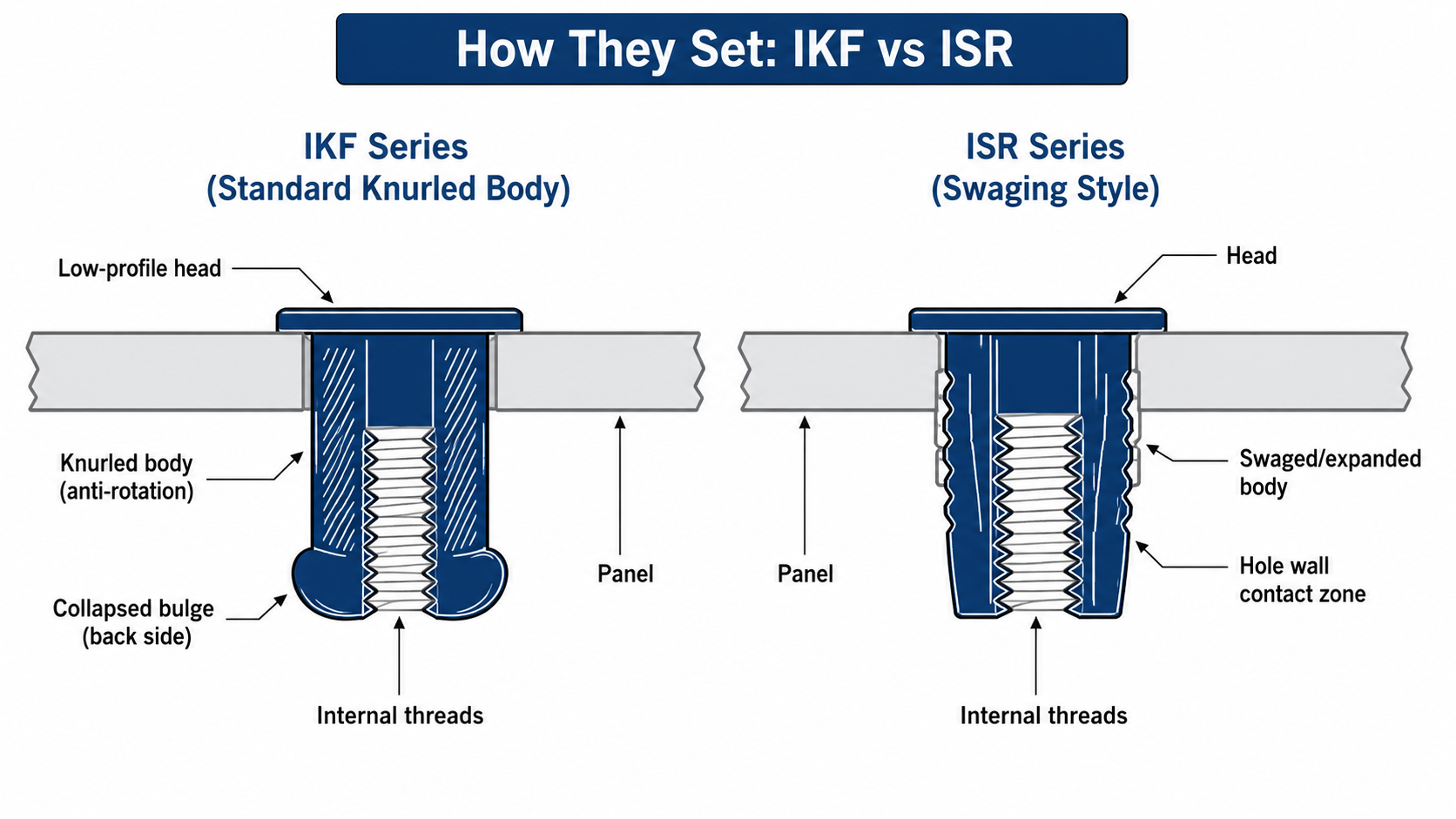
IKF Series (Standard Knurled Body, Low Profile Head)
The IKF series is the workhorse rivet nut — a thinwall design with a knurled body and a low-profile flange head. The body collapses against the back side of the panel during installation, and the knurled flange grips the front face to prevent rotation. Available in steel yellow zinc, aluminum, and 18-8 stainless across all common inch and metric sizes.
- Use IKF when: you have access to drill a clean round hole, you know your panel thickness, and you need a permanent threaded socket in sheet metal, panels, or tubing.
- Common applications: automotive accessories, sheet metal fabrication, HVAC ductwork, equipment manufacturing, signage, electronics enclosures.
- Each size offered in two grip ranges (short and long) to match your sheet thickness exactly.
ISR Series (Swaging Style, Unlimited Maximum Grip)
The ISR series is the swaging-style rivet nut for blind-hole installations and applications where panel thickness is unknown. Unlike fixed-grip IKF, the ISR has unlimited maximum grip — it will set in any sheet thicker than 0.030". The body swages outward against the inside of the hole rather than collapsing against the back face, making it suitable for closed cavities and structural panels.
- Use ISR when: you don’t know the exact panel thickness, the back side isn’t accessible, or you need one rivet nut to handle a range of sheet thicknesses.
- Common applications: blind-hole installations, structural panels of variable thickness, closed cavity assemblies, fluid containment.
- One grip range fits all — works in any sheet over 0.030".
Quick Decision: IKF vs ISR
| If your application is… | Choose |
|---|---|
| Standard sheet metal, known thickness, both sides of panel accessible | IKF (matched grip range) |
| Blind hole, closed cavity, no back-side access | ISR |
| Variable or unknown sheet thickness | ISR |
| Production run, same panel thickness every time | IKF (lower cost per piece) |
| Stainless, marine, or food-grade required | IKF (stainless option available) |
Step 2: Choose Your Material
Eugene Fastener stocks three materials in the IKF series. Picking the right one comes down to the environment, the load, and the cost target.
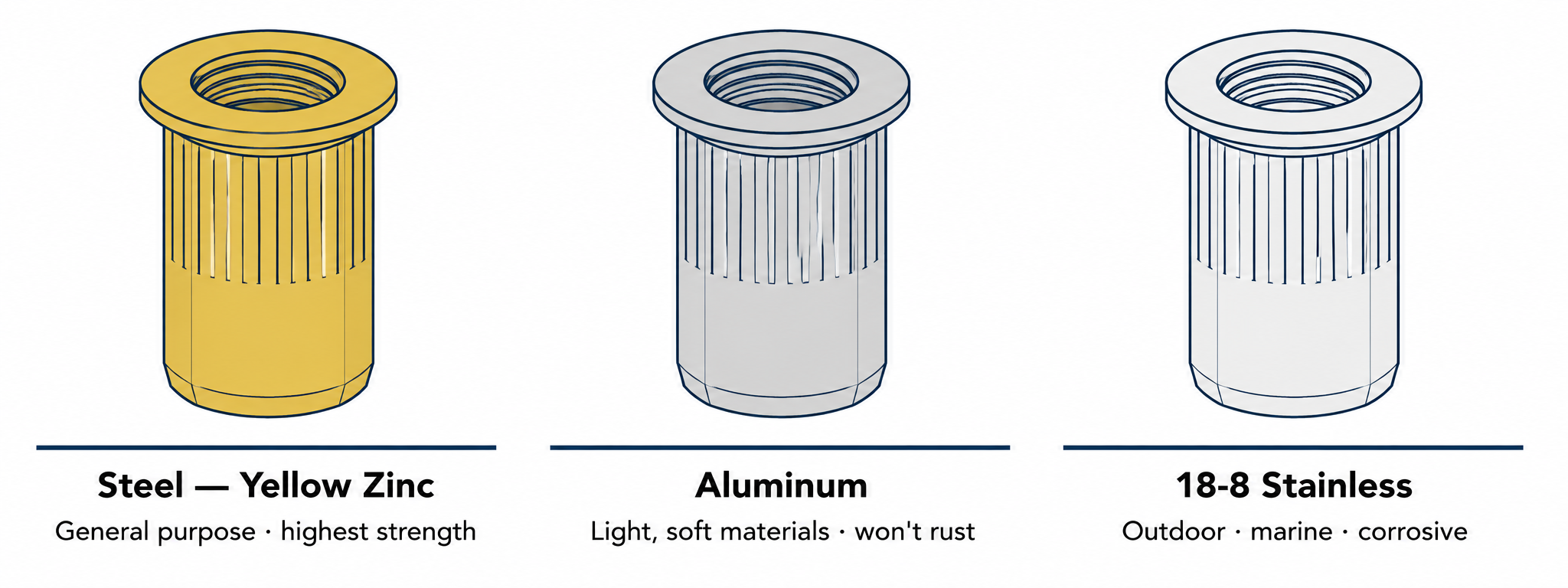
| Material | Best For | Avoid When |
|---|---|---|
| Steel, Yellow Zinc Plated | General industrial, automotive, structural, equipment manufacturing — the default choice for ~70% of applications. Highest pull-out strength and torque-out resistance per dollar. | Marine, persistently wet, or long-term outdoor exposure — zinc plating will eventually corrode through. |
| Aluminum, Plain | Lightweight applications, automotive aftermarket, off-road accessories, aerospace non-structural panels, electronics enclosures — when weight matters or you need non-magnetic. | High-torque applications, structural panels, applications subject to repeated cycling — aluminum has lower pull-out strength than steel. |
| 18-8 Stainless Steel | Marine hardware, food processing, outdoor exposure, medical equipment, chemical processing — anywhere corrosion resistance is required and cost is secondary to longevity. | High-volume general industrial use where steel zinc would suffice — stainless costs significantly more and offers slightly lower torque-out resistance than zinc-plated steel. |
If you’re unsure: default to steel yellow zinc. It’s the standard for the vast majority of industrial applications and the best value per fastener. Step up to stainless only when you have a specific corrosion or contamination requirement.
Step 3: Choose Your Thread Size
Pick the thread size that matches the bolt or screw you’ll thread into the rivet nut. Larger threads provide more pull-out strength but require larger holes — not always practical in thin panels.
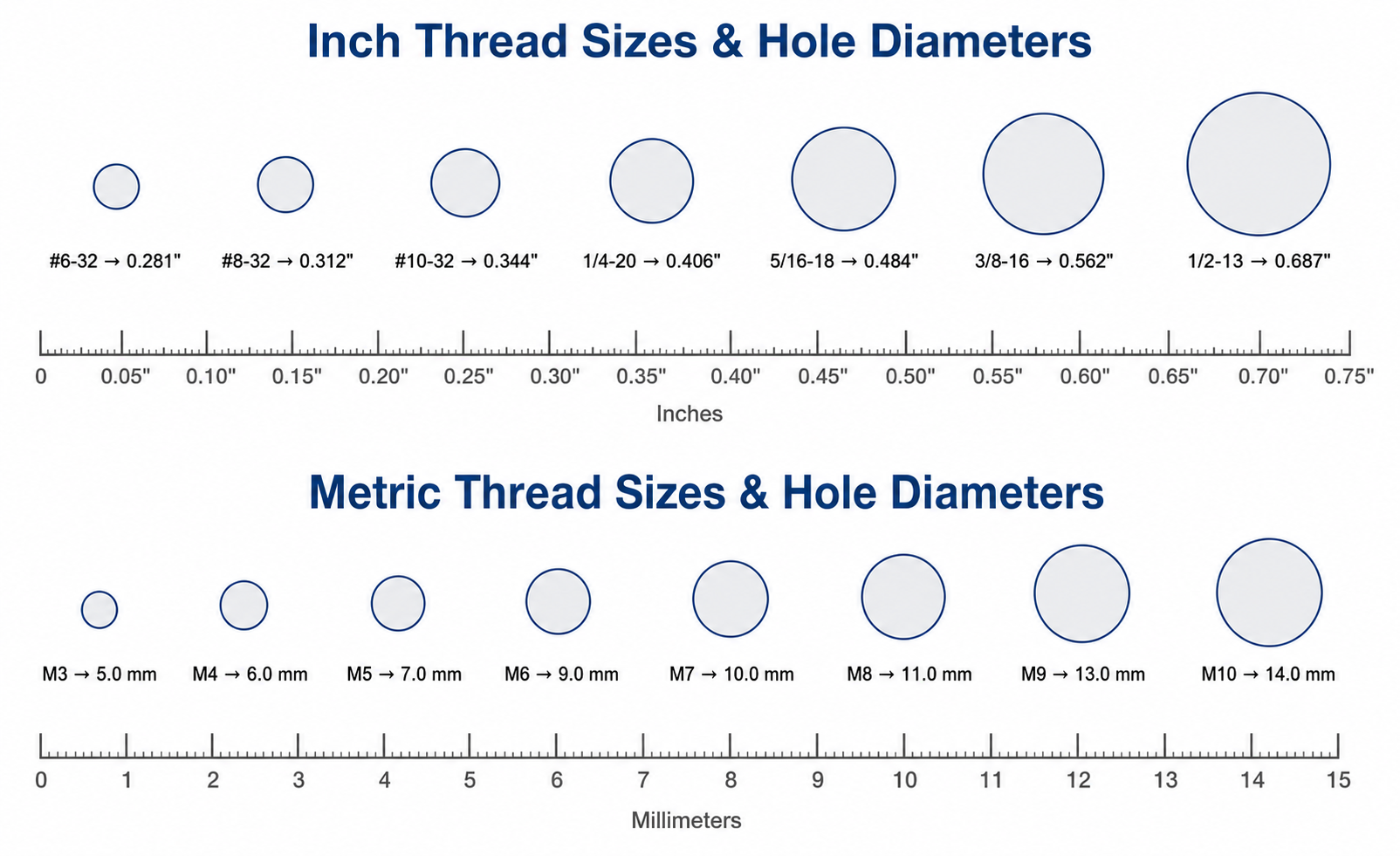
Inch Thread Sizes (UNC / UNF)
| Thread | Hole Size | Common Applications |
|---|---|---|
| #4-40 UNC | 0.1875" | Light electronics enclosures, signage, very thin sheet |
| #6-32 UNC | 0.266" | Light gauge sheet metal, electronics, automotive trim |
| #8-32 UNC | 0.266" | Light sheet metal, control panels, light bracketry |
| #10-24 UNC | 0.297" | HVAC ductwork, light enclosures, automotive trim |
| #10-32 UNF | 0.297" | Same as 10-24 but with finer thread for vibration applications |
| 1/4-20 UNC | 0.391" | General industrial, automotive accessories, panel mounting (most popular size) |
| 5/16-18 UNC | 0.531" | Equipment manufacturing, structural attachments, off-road accessories |
| 3/8-16 UNC | 0.531" | Heavy panel mounting, off-road bumpers, frame attachments |
| 1/2-13 UNC | 0.688" | Frame and chassis attachments, heavy equipment, structural use |
Metric Thread Sizes
| Thread | Hole Size | Common Applications |
|---|---|---|
| M4 × 0.7 | 6.75 mm | European/import equipment, electronics, light bracketry |
| M5 × 0.8 | 7.60 mm | Automotive aftermarket (especially European cars), light panel mounting |
| M6 × 1.0 | 10.0 mm | European/import equipment, automotive aftermarket (most popular metric size) |
| M8 × 1.25 | 13.5 mm | Automotive accessories, equipment manufacturing |
| M10 × 1.5 | 13.5 mm | Heavier panel mounting, automotive aftermarket structural |
| M12 × 1.75 | 17.47 mm | Frame attachments, heavy equipment |
For complete drill bit recommendations matched to every size, see our Rivet Nut Drill Bit & Hole Size Chart.
Step 4: Choose Your Grip Range (IKF Only)
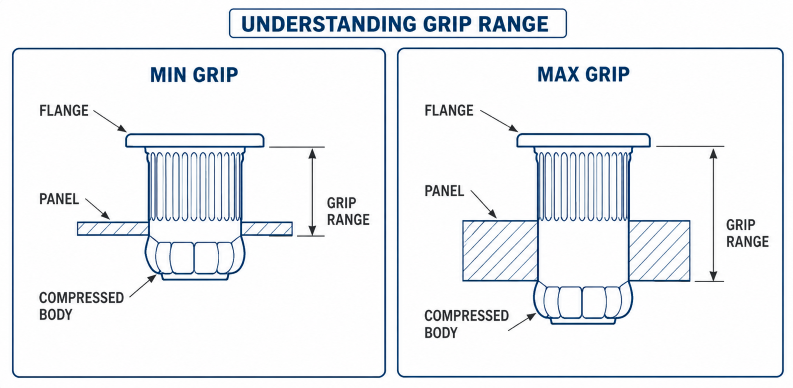
The grip range is the panel thickness the rivet nut can accommodate. Each IKF size is offered in two grip ranges: short grip for typical sheet metal, long grip for thicker panels or stacks. Picking the wrong grip range — either too short or too long — prevents the rivet nut from setting properly.
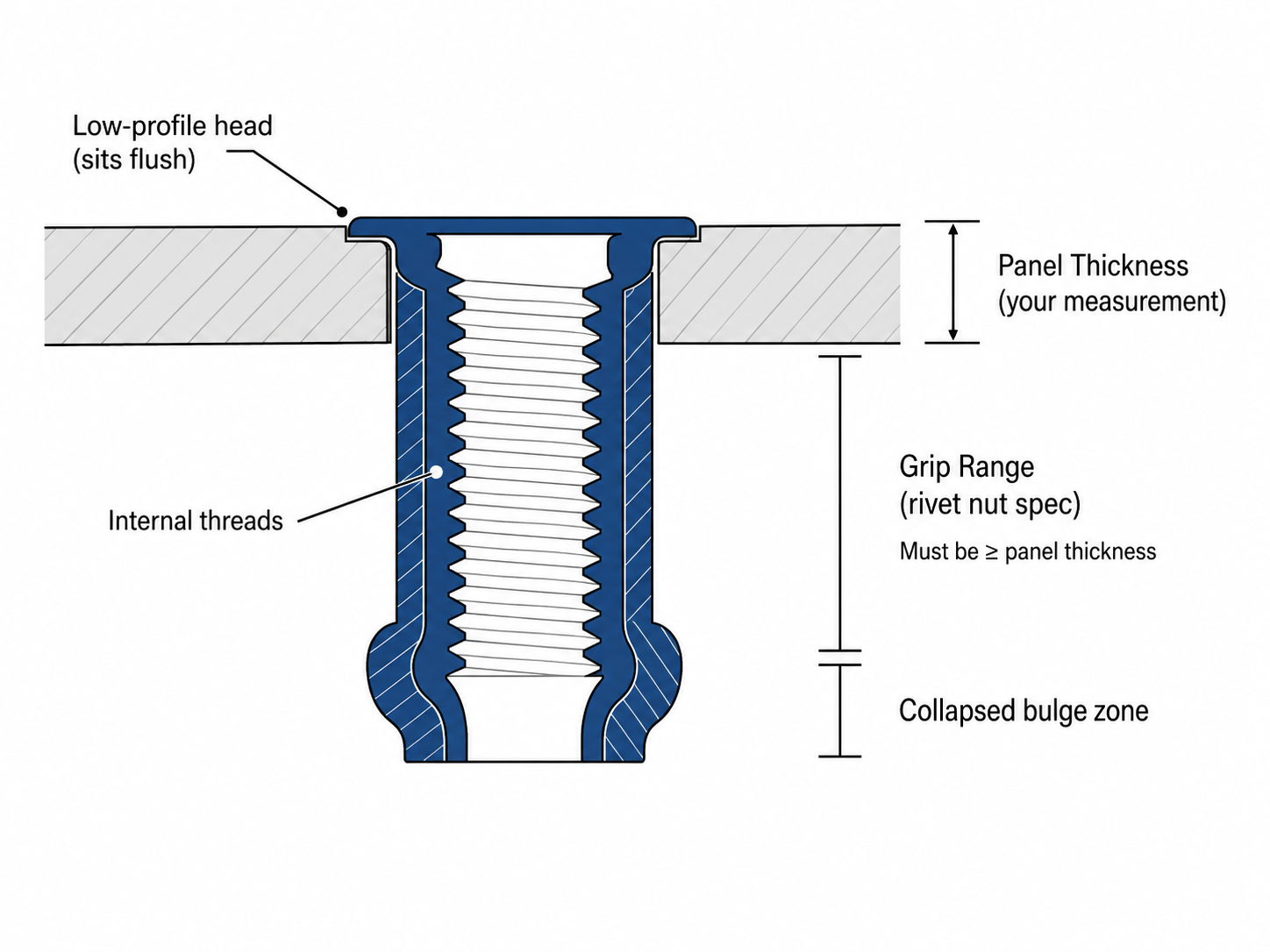
How to Measure Your Panel Thickness
- Measure your panel with calipers or a thickness gauge at the point where you’ll install the rivet nut.
- If you’re installing through stacked panels, measure the total thickness of the stack.
- Add a small margin (0.005"-0.010") for paint, finish, or coatings.
- Pick the grip range that contains your measured thickness.
Grip Range Selection Chart (IKF Series)
| Thread | Short Grip | Long Grip | Extra-Long Grip (1/2-13 only) |
|---|---|---|---|
| #6-32 UNC | 0.020" - 0.080" | 0.080" - 0.130" | — |
| #8-32 UNC | 0.020" - 0.080" | 0.080" - 0.130" | — |
| #10-24 UNC | 0.020" - 0.130" | 0.130" - 0.225" | — |
| #10-32 UNF | 0.020" - 0.130" | 0.130" - 0.225" | — |
| 1/4-20 UNC | 0.027" - 0.165" | 0.165" - 0.260" | — |
| 5/16-18 UNC | 0.027" - 0.150" | 0.150" - 0.312" | — |
| 3/8-16 UNC | 0.027" - 0.150" | 0.150" - 0.312" | — |
| 1/2-13 UNC | 0.063" - 0.200" | 0.200" - 0.350" | 0.350" - 0.500" |
| M4 × 0.7 | 0.50 - 2.00 mm | 2.00 - 3.30 mm | — |
| M5 × 0.8 | 0.50 - 3.30 mm | 3.30 - 5.70 mm | — |
| M6 × 1.0 | 0.70 - 4.20 mm | 4.20 - 6.60 mm | — |
| M8 × 1.25 | 0.70 - 3.80 mm | 3.80 - 7.90 mm | — |
| M10 × 1.5 | 0.70 - 3.80 mm | 3.80 - 7.90 mm | — |
| M12 × 1.75 | 1.60 - 5.10 mm | 5.10 - 8.90 mm | — |
Note for ISR series: ISR rivet nuts have unlimited maximum grip range and work in any sheet thicker than 0.030". There’s no grip selection to make with ISR — one part covers all panel thicknesses.
Frequently Asked Questions
What if my panel thickness is right at the edge between short and long grip?
Pick the grip range where your panel sits in the middle, not at the edge. A panel that’s exactly at the boundary (e.g., 0.165" for a 1/4-20) might be at the absolute max of short grip or absolute min of long grip — neither is ideal. Long grip is usually the safer choice if you’re right on the line, since a too-thin panel in long grip just leaves a small gap (still functional), while a too-thick panel in short grip won’t set at all.
Can I use a stainless rivet nut in an aluminum panel?
Yes, but be aware of galvanic corrosion if the assembly is exposed to moisture. Stainless in contact with aluminum in a wet environment can cause the aluminum to corrode preferentially. For dry indoor applications it’s fine. For outdoor or marine, either match the materials (aluminum rivet nut in aluminum panel) or use an isolating washer/sealant.
Why are there both UNC and UNF options for #10 (10-24 vs 10-32)?
#10-24 (UNC, coarse thread) is more common in general industrial use — it tolerates rougher handling and has more resistance to stripping. #10-32 (UNF, fine thread) is preferred for vibration applications and when finer thread engagement is needed (e.g., automotive accessories, instrumentation). Match whichever your bolt or stud uses.
What size rivet nut should I use for a 1/4-20 bolt?
Use a 1/4-20 rivet nut. The rivet nut thread must match the bolt thread exactly. Same for every other size — M6 bolt requires M6 rivet nut, 5/16-18 bolt requires 5/16-18 rivet nut, and so on.
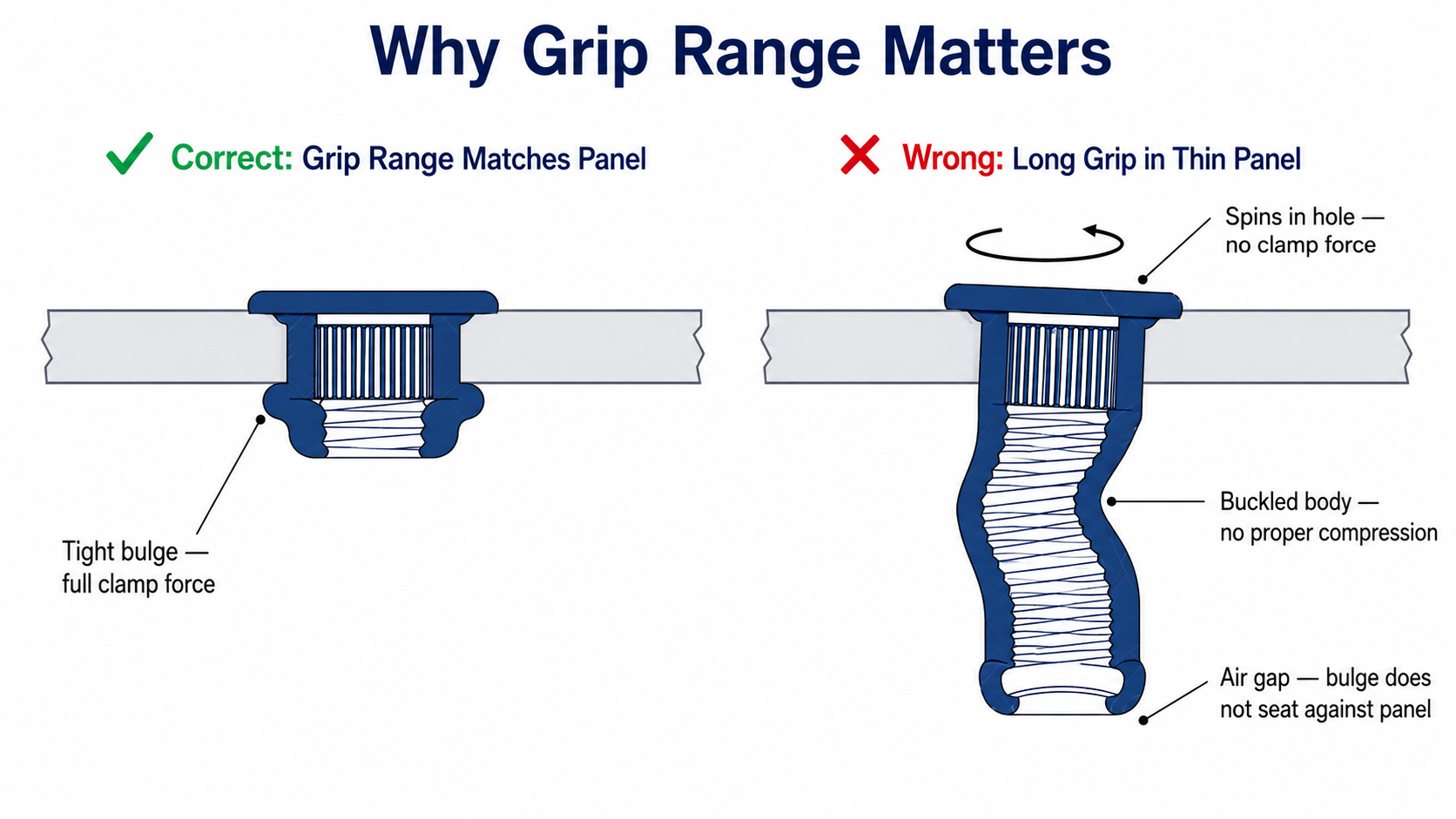
Can I use a long-grip rivet nut in a thinner panel to save part numbers?
No. A long-grip rivet nut in a too-thin panel won’t collapse against the back side properly — it will leave the body extending past the panel, weakening the install. Match the grip range to your actual panel thickness. The two grip ranges per size are not interchangeable.
Do I need different rivet nuts for stainless steel panels vs mild steel panels?
The rivet nut material is selected for the environment (corrosion resistance) and load, not the panel material. You can install a steel zinc rivet nut into a stainless panel and vice versa. The drill bit changes (use cobalt for stainless panels) but the rivet nut doesn’t.
Related Resources
- Rivet Nut Drill Bit & Hole Size Chart — matching drill bits for every size and series with Eugene Fastener Triumph SKUs
- Rivet Nut Tool Selection Guide — choosing between hand, pneumatic, pneudraulic, and cordless installation tools
- How to Install a Rivet Nut — step-by-step installation walkthrough with common pitfalls
- Rivet Nut vs Plus Nut vs Jack Nut vs Well Nut — comparing rivet nuts to alternative blind threaded fasteners
- Shop Rivet Nuts (IKF & ISR)
- Shop All Rivets & Inserts