Socket Head Cap Screws
Socket head cap screws are the most widely used high-strength fastener in precision manufacturing, tooling, and machine building. Their cylindrical head and internal hex drive allow installation in counterbored holes and tight spaces where a standard hex bolt and wrench cannot reach — while delivering clamping force that exceeds Grade 8 hex bolts of equivalent size. Eugene Fastener stocks socket head cap screws in alloy steel and stainless steel, in inch and metric sizes, from stock in Eugene, Oregon.
Helpful Guides
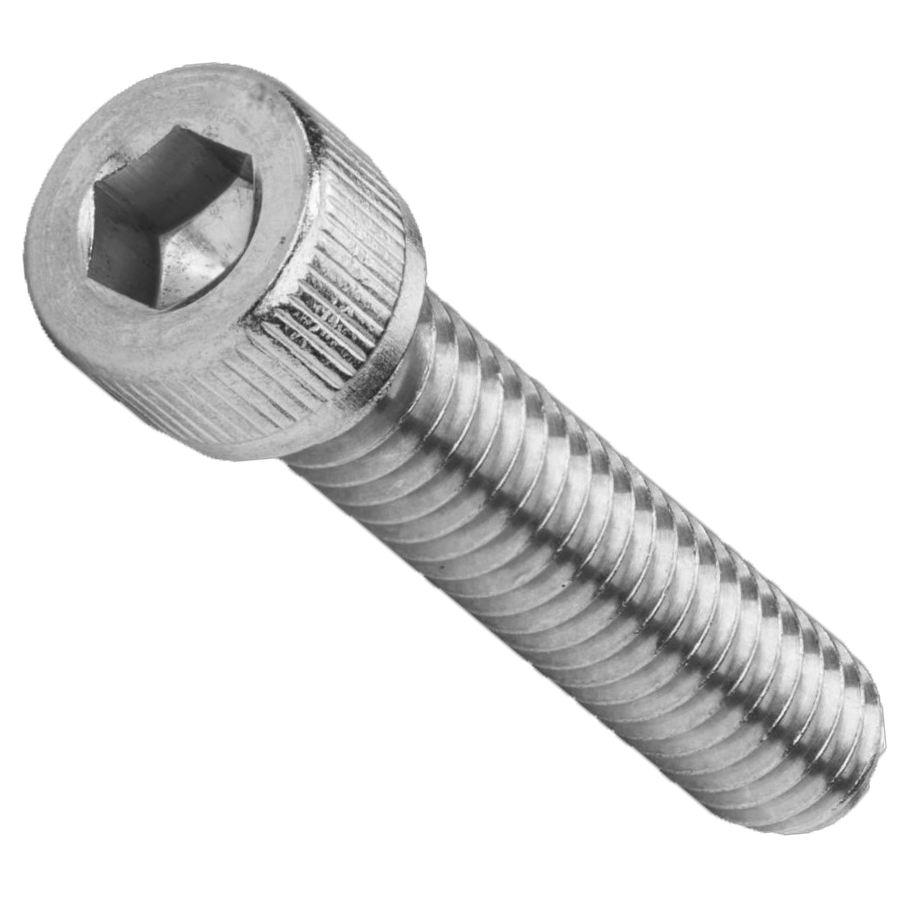
Socket Head Cap Screws — Alloy and Stainless Steel, Inch and Metric
Socket head cap screws (SHCS) — also called Allen cap screws, hex socket cap screws, or cylinder head screws — are the standard fastener for precision machinery, molds, tooling, hydraulic components, and OEM mechanical assemblies. The cylindrical head is driven by an internal hex key, eliminating the need to swing a wrench — critical in the confined spaces typical of machine tool tables, hydraulic manifolds, die sets, and robotic structures. Alloy steel SHCS are among the strongest commercially available fasteners, with a minimum tensile strength of 170,000 PSI that exceeds Grade 8 hex bolts.
Alloy Steel Socket Head Cap Screws
Inch-series alloy steel socket head cap screws conform to ASTM A574, with minimum tensile strength of 170,000 PSI for sizes #0 through 1/2" and 180,000 PSI for 5/8" and larger. They are heat treated and through-hardened. Standard finish is plain (bright) or black oxide — black oxide is most common in industrial applications and provides light corrosion protection. Alloy SHCS are available in sizes from #0-80 through 1-1/2"-6 and in lengths from 1/8" through 6" and longer for special orders.
Stainless Steel Socket Head Cap Screws
Stainless steel socket head cap screws are available in 18-8 (302/304) and 316 stainless steel. 18-8 provides excellent general corrosion resistance for food processing equipment, pharmaceutical machinery, outdoor structures, and marine hardware. 316 stainless adds molybdenum for superior resistance to chlorides and salt water. Tensile strength for stainless SHCS is lower than alloy — typically 85,000–125,000 PSI for 18-8 depending on size — so verify load requirements before substituting stainless for alloy in a structural application.
Metric Socket Head Cap Screws
Metric socket head cap screws conform to DIN 912 (alloy, Class 12.9 or Class 10.9) and ISO 4762. Class 12.9 provides the highest tensile strength (1,220 MPa / ~177,000 PSI) and is standard for precision machinery. Class 10.9 (1,040 MPa) is used where slightly lower strength is acceptable. Metric stainless SHCS conform to DIN 912 in A2-70 (304) or A4-70 (316) property classes. Common sizes in stock run M2 through M24; larger sizes available by special order.
Counterbore Reference
Socket head cap screws are typically installed in a counterbored hole — a stepped hole where the cylindrical head seats flush or below the surface. The counterbore diameter must clear the head diameter; the counterbore depth must equal or exceed the head height. Common inch counterbore dimensions: 1/4"-20 SHCS uses 3/8" cbore diameter, 1/4" depth; 3/8"-16 uses 9/16" cbore, 3/8" depth; 1/2"-13 uses 3/4" cbore, 1/2" depth. Consult ASME B18.3 or your machinist's reference for a complete table.
SHCS vs. Grade 8 Hex Bolts — Which Is Stronger?
ASTM A574 alloy socket head cap screws (170,000 PSI min. tensile for sizes through 1/2") are stronger than SAE Grade 8 hex bolts (150,000 PSI min. tensile). For sizes 5/8" and larger, SHCS reaches 180,000 PSI vs. Grade 8's 150,000 PSI. The main trade-off is bearing surface: a socket head has a smaller head bearing area than a hex bolt head of the same thread size. If clamp load distribution is critical, a hardened flat washer under the socket head compensates for the smaller bearing area.
Frequently Asked Questions
What does SHCS stand for?
SHCS stands for Socket Head Cap Screw. You may also see SKT HD CAP SCR or HX SKT CAP SCR on engineering drawings. The metric equivalent is sometimes labeled DIN 912 or ISO 4762 on European prints.
What hex key size do I need for socket head cap screws?
Hex key size is standardized by thread size. Common inch pairings: #10-32 uses 5/32"; 1/4"-20 uses 3/16"; 5/16"-18 uses 1/4"; 3/8"-16 uses 5/16"; 1/2"-13 uses 3/8"; 5/8"-11 uses 1/2". Metric: M4 uses 3mm; M5 uses 4mm; M6 uses 5mm; M8 uses 6mm; M10 uses 8mm; M12 uses 10mm. Always use the correct size — an undersized key will round the socket.
Are socket head cap screws the same as Allen bolts?
Yes. "Allen bolt," "Allen cap screw," and "hex socket cap screw" all refer to a socket head cap screw. "Allen" is a brand name (Allen Manufacturing Company) that became a generic term for internally driven hex socket fasteners.
Can I use socket head cap screws with a standard nut and washer?
Yes — in a through-hole application with a nut and washer, SHCS work the same as hex bolts. The advantage remains the compact head and internal drive for tight-space installation. Use a hardened flat washer under the head if the joint requires maximum bearing area.
What is the difference between Class 10.9 and Class 12.9 metric socket head cap screws?
Class 12.9 has higher tensile strength (1,220 MPa vs. 1,040 MPa for Class 10.9) and is the standard for precision machinery. Class 10.9 is used where slightly lower strength is acceptable, often at lower cost. For most industrial machine-building applications, specify Class 12.9.
Socket head cap screws are the backbone of machine-built assemblies and are almost always used alongside flat washers, lock washers, and hardened washers to distribute clamp load and resist vibration loosening. For applications requiring precision location in addition to clamping, shoulder bolts and dowel pins pair naturally with SHCS. The complete socket fastener family — including flat head socket cap screws, button head cap screws, and socket set screws — is available through the Sockets category.
Goes Well With