Sockets
Socket fasteners are internally driven fasteners that accept an Allen key (hex key) rather than a slotted, Phillips, or external hex driver — making them the go-to choice when high torque, flush seating, or installation in tight spaces is required. Eugene Fastener stocks a complete line of socket screws and socket cap screws in alloy steel and stainless steel, covering inch and metric sizes, from stock in Eugene, Oregon. The socket fastener family includes flat head socket cap screws for countersunk applications, socket head cap screws for standard through-hole assemblies, set screws for shaft collars and gears, shoulder bolts for pivoting and sliding components, and more.
Helpful Guides
Socket Screws and Socket Cap Screws — Alloy & Stainless Steel, Inch and Metric
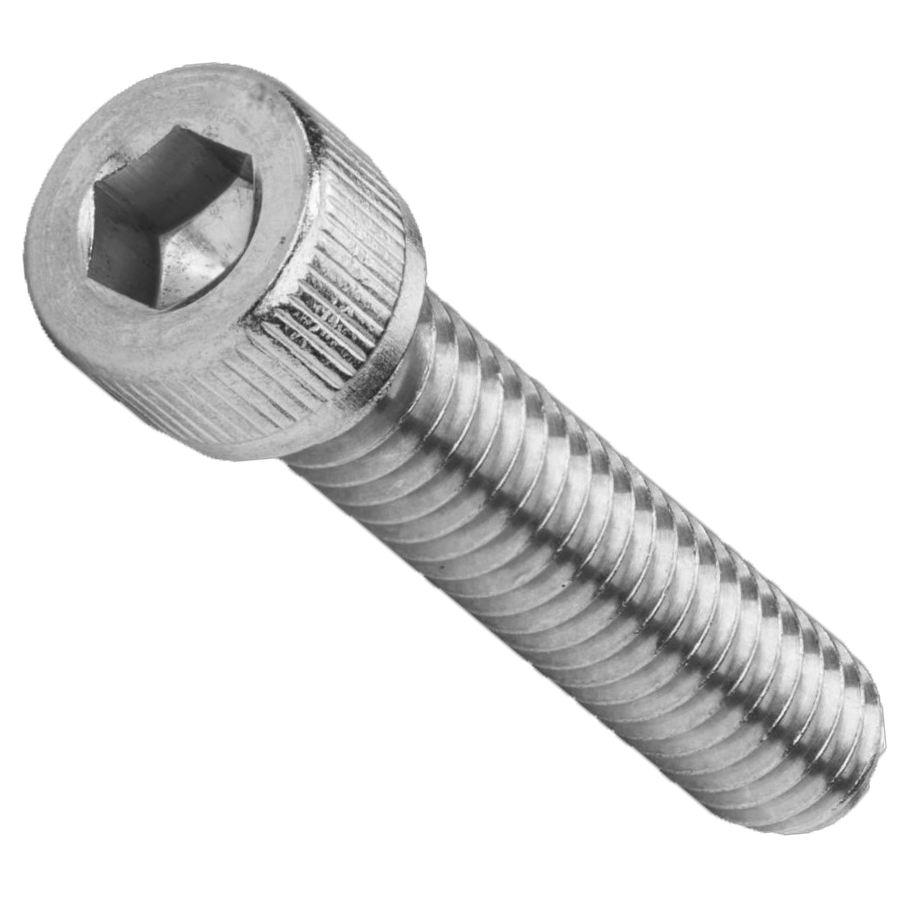
Socket fasteners — also called Allen screws, hex socket screws, or internally wrenched fasteners — are defined by a hex-shaped recess machined into the head (or body, in the case of set screws). A hex key is inserted into this recess to drive the fastener. Because the drive engages over the full depth of the recess rather than just a surface profile, socket fasteners handle significantly higher torque than Phillips or slotted drivers of comparable size without stripping. The compact head also allows installation in counterbored holes and recessed pockets where a wrench or socket cannot reach.
Socket Fastener Types — Which One Do You Need?
Socket Head Cap Screws (SHCS) are the most widely used socket fastener. A full-height cylindrical head sits above the workpiece, providing a large bearing surface and high clamp load. Alloy steel versions meet ASTM A574, providing 170,000 PSI minimum tensile strength — stronger than Grade 8 hex bolts. Used throughout manufacturing, tooling, machine building, and OEM assembly.
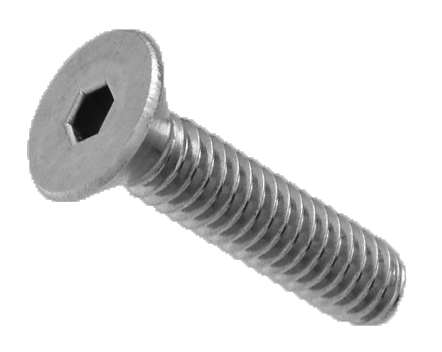
Flat Head Socket Cap Screws (FHSCS) have a countersunk head that sits flush with or below the workpiece surface. The head angle is 82° for inch series (ASME B18.3) and 90° for metric series (DIN 7991) — the mating countersunk hole must match. Used in panels, brackets, enclosures, and assemblies where a protruding head would interfere with mating parts or movement.
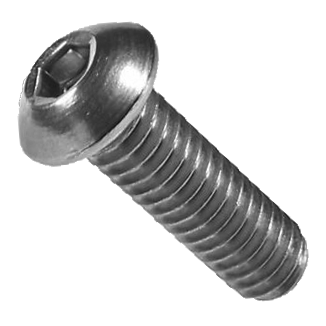
Button Head Socket Cap Screws (BHCS) feature a low-profile, dome-shaped head with a wider, shallower bearing surface. The reduced head height makes them popular for equipment guards, covers, and consumer-facing hardware where a clean aesthetic is preferred. Note: button head cap screws have a lower tensile rating than standard socket head cap screws — confirm load requirements before substituting.
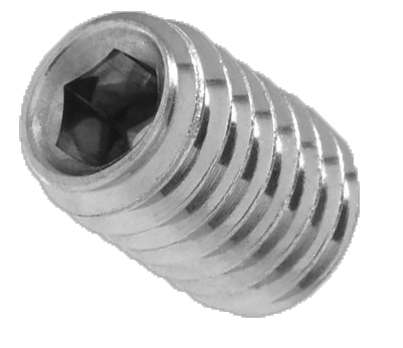
Socket Set Screws are headless, threaded their full length, and driven entirely by the internal hex socket. They lock gears, pulleys, cams, and collars onto shafts by bearing against the shaft surface with a hardened point. Point styles include cup (most common), flat, cone, oval, and dog (knurled cup). Available in alloy steel and stainless steel.
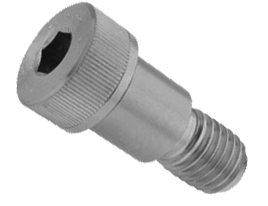
Shoulder Bolts (Shoulder Screws) have a precision-ground cylindrical shoulder between the head and the threaded shank. The unthreaded shoulder — not the threads — is the controlling dimension; it acts as a pivot point, guide pin, or spacer in jigs, fixtures, die sets, and cam-follower assemblies. Shoulder diameter and shoulder length are specified separately from thread size.
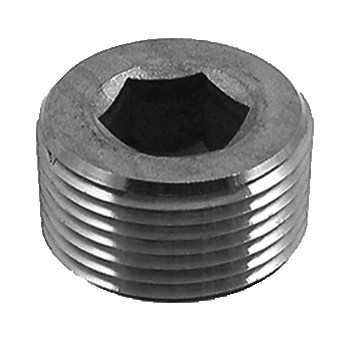
Hex Socket Pipe Plugs are pipe plugs with an internal hex drive, allowing installation in confined spaces where a wrench cannot swing. Available in NPT thread and multiple materials. Used to seal ports in hydraulic manifolds, valve bodies, and fluid system components.
Alloy Steel vs. Stainless Steel Socket Screws
Alloy steel socket screws are heat treated to ASTM A574, yielding a minimum tensile strength of 170,000 PSI (sizes #0 through 1/2") — making them among the strongest commercially available fasteners. A black oxide finish is standard; plain (bright) and zinc-plated finishes are also available. For corrosive environments, stainless steel socket screws (18-8 / 302-304 or 316) provide excellent corrosion resistance at reduced tensile strength (approximately 85,000–125,000 PSI). 316 stainless adds molybdenum for superior resistance to chlorides and marine exposure. Metric socket screws follow ISO and DIN standards: Class 12.9 for alloy, A2-70 or A4-70 for stainless.
Hex Key (Allen Wrench) Reference
The correct hex key size is determined by thread diameter and is standardized. Common inch pairings: #8-32 and #10-32 use 5/32"; 1/4-20 uses 3/16"; 5/16-18 uses 1/4"; 3/8-16 uses 5/16"; 1/2-13 uses 3/8"; 5/8-11 uses 1/2". Common metric pairings: M4 uses 3mm; M5 uses 4mm; M6 uses 5mm; M8 uses 6mm; M10 uses 8mm; M12 uses 10mm. Using an undersized key risks rounding the socket — always use the correct size.
Frequently Asked Questions
What is the difference between a socket screw and a cap screw?
"Cap screw" refers to a fastener with a distinct driving head — socket head, flat head, or button head. "Socket screw" is broader and includes headless fasteners like set screws. All socket cap screws are socket screws, but socket set screws are not cap screws.
Are Allen screws and socket screws the same thing?
Yes. "Allen screw" or "Allen bolt" is a common name for any socket screw — derived from the Allen Manufacturing Company, which popularized the internal hex drive in the early 20th century. The correct technical term is "hex socket" or "internal hex" fastener.
Can alloy socket head cap screws replace Grade 8 hex bolts?
In most applications, yes. ASTM A574 alloy socket head cap screws (170,000 PSI) are stronger than Grade 8 hex bolts (150,000 PSI minimum). The bearing surface under a socket head is smaller than under a hex head, so verify that joint design accommodates this if clamp load distribution is critical.
What is the difference between a shoulder bolt and a cap screw?
A shoulder bolt (shoulder screw) has a precision-ground, unthreaded shoulder between the head and the threaded end. The shoulder — not the threads — is the load-bearing surface. Cap screws are threaded up to or near the head with no unthreaded shoulder. They serve fundamentally different functions in an assembly.
Do socket set screws come in different points?
Yes. The most common is the cup point, which bites into the shaft for high holding power. Flat points are used on hardened shafts or where minimal surface damage is needed. Cone points lock permanently into a mating dimple. Oval points are used on soft shafts where rotation adjustment is needed. Dog (knurled cup) points are used for frequent adjustment.
Socket fasteners are commonly used alongside flat washers and hardened washers to distribute clamp load across the bearing surface, and with split or tooth lock washers to resist vibration-induced loosening in dynamic applications. For assemblies that require close-tolerance location in addition to clamping, dowel pins are frequently used in combination with socket head cap screws. Eugene Fastener also stocks hex bolts and structural bolts, machine screws, stud bolts, and a full range of nuts and washers for related fastening needs. If your assembly uses socket screws with thin-wall or non-threaded materials, see our threaded inserts and rivet nuts for a complete solution.
Goes Well With