Socket Set Screws
Socket set screws are headless, fully threaded fasteners driven by an internal hex key — used to lock gears, pulleys, cams, and collars onto shafts by bearing against the shaft surface with a hardened point. Because they have no head, a properly installed set screw sits completely below the surface of the component, creating a flush, snag-free assembly. Eugene Fastener stocks socket set screws in alloy steel and stainless steel, in inch and metric sizes, with multiple point styles to match different shaft and holding requirements.
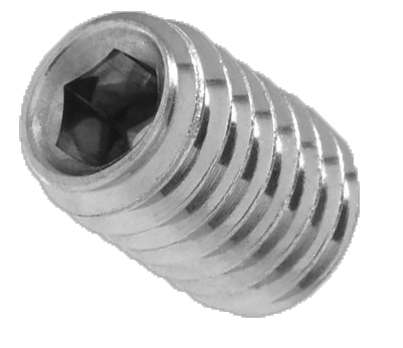
Socket Set Screws — Cup Point, Flat Point, Alloy and Stainless Steel
Socket set screws — also called grub screws, hex socket set screws, or Allen set screws — are threaded through their entire length with no head. Rather than clamping two parts together like a cap screw, a set screw is threaded into a tapped hole in a hub, collar, or gear, and its point presses against the shaft beneath to resist rotation and axial movement. They conform to ASME B18.3 (inch series) and DIN 913–916 (metric series).
Set Screw Point Styles — Which One to Use
Cup Point is the most common point style, accounting for the majority of set screw applications. The hardened, concave tip bites into the shaft surface, providing strong resistance to both rotation and axial movement. Cup point set screws leave a small indentation on the shaft — acceptable in most applications, and desirable when the set screw must be repositioned and re-engaged accurately.
Flat Point applies pressure over a flat area rather than a point, minimizing shaft damage. Used on hardened or precision-ground shafts where marring is not acceptable, and in applications requiring frequent adjustment. Holding power is lower than cup point.
Cone Point digs into or seats in a matching dimple in the shaft, creating a semi-permanent lock with the highest holding power of any point style. Used where the set screw will not be moved after installation. Not suitable for adjustment applications.
Oval Point has a rounded tip that bears against the shaft with minimal surface damage. A good choice for soft shafts, optical equipment, and applications requiring periodic adjustment without progressive shaft damage from repeated contact.
Dog Point (Knurled Cup) features an extended, cylindrical pilot that seats into a corresponding hole or slot in the shaft, providing positive keying rather than friction. Used in applications requiring accurate repositioning, where the set screw must be removed and reinstalled repeatedly in exactly the same location.
Alloy Steel Socket Set Screws
Alloy steel set screws are through-hardened to RC 45–53 per ASME B18.3, making the point hard enough to bite into and hold on unhardened steel shafts. This hardness is what allows a small cup point to resist significant torque loads. Standard finish is plain; black oxide is available. Alloy steel set screws should not be used against hardened shafts — the point will not penetrate, and fretting may result.
Stainless Steel Socket Set Screws
18-8 stainless steel set screws provide corrosion resistance for food service, washdown, and outdoor applications. Stainless is softer than hardened alloy steel — stainless set screws have lower holding power against steel shafts and are more prone to galling. Apply anti-galling compound (Never-Seez or equivalent) when installing stainless set screws in stainless tapped holes.
Square Head Set Screws
Eugene Fastener also stocks square head set screws — an older style that predates the internal hex socket drive. Square head set screws are driven with an open-end wrench rather than a hex key, allowing much higher applied torque. They are commonly found in legacy machinery, agricultural equipment, and applications where the larger wrench engagement is needed for high-torque locking. Available in alloy steel with cup point.
Frequently Asked Questions
How tight should a set screw be?
Set screws should be tightened to the manufacturer's recommended torque for the thread size and point style. Over-tightening can shear the screw or cause excessive shaft damage. Under-tightening will allow the assembly to shift under load. Use a calibrated torque driver where precise holding force is required.
Can set screws be reused?
Cup point set screws can generally be reused a limited number of times, as long as the point remains intact and the threads are undamaged. Cone point set screws that have been fully seated in a dimple may be difficult to remove without shaft damage. Replace any set screw that shows signs of thread damage, point deformation, or socket rounding.
What is the difference between a set screw and a grub screw?
They are the same fastener. "Grub screw" is the common British English term; "set screw" is standard in American English. Both refer to a headless, internally-driven fastener used to secure a component to a shaft.
Do I need a nylon patch set screw for vibration resistance?
Nylon-patch (or nylon-tip) set screws have a plastic insert that creates additional friction against the shaft, resisting loosening under vibration. They are recommended in high-vibration environments — power transmission, motor applications, and mobile equipment — where a standard cup point may back out over time.
Socket set screws are a core component in power transmission assemblies alongside shaft keys, keystock, and dowel pins, and are often used in combination with socket head cap screws and shoulder bolts in jig and fixture builds. For other socket fastener types — including flat head and button head socket cap screws, shoulder bolts, and socket head cap screws — see the full Sockets category. Eugene Fastener also stocks a full range of nuts, washers, and machine screws for related fastening applications.
Goes Well With