Nylon Socket Set Screws
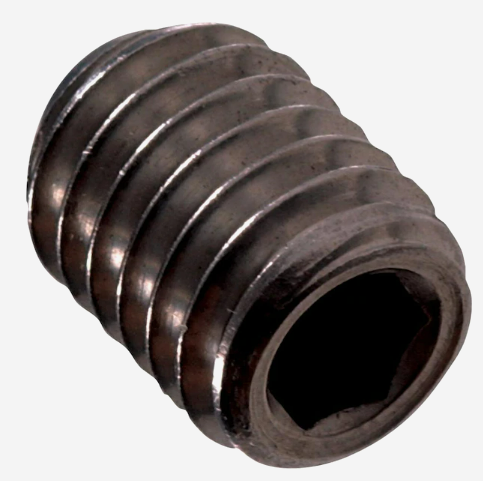
Nylon tip socket set screws have an alloy steel body with a replaceable or molded nylon insert at the point. The soft nylon tip bears against the shaft surface rather than biting into it — protecting the shaft from marring, indentation, or surface damage. They are also commonly used in vibration-prone assemblies because the nylon creates additional friction against the shaft that resists backing out. Eugene Fastener stocks nylon tip socket set screws in inch sizes from stock in Eugene, Oregon.
No items match your selected filters. Please change or reset your filters to try again.
Nylon Tip Socket Set Screws — Shaft Protection and Vibration Resistance
Shop Nylon Tip Socket Set Screws
Nylon tip socket set screws serve two distinct purposes: protecting shaft surfaces from damage and resisting vibration-induced loosening. Unlike alloy cup point set screws that grip by biting into the shaft, the nylon tip bears against the shaft with a low-friction, non-marring contact surface. This makes them the correct choice in applications where shaft surface integrity must be maintained — precision ground shafts, plated or coated shafts, optical and instrument components, and any application where the set screw may be repositioned frequently without causing cumulative shaft damage.
Shaft Surface Protection
A standard alloy cup point set screw leaves an indentation in the shaft surface each time it is tightened. On precision components — ground shafts used as bearing races, plated decorative hardware, instrument shaft assemblies — this indentation is unacceptable. The nylon tip deforms slightly to conform to the shaft surface and distributes load over a larger contact area, leaving no metal-to-metal mark. Note that nylon tips will deform over time under repeated installation; most nylon tip set screws are designed with a replaceable or semi-replaceable nylon insert for this reason.
Vibration Resistance
The nylon tip creates additional friction between the set screw body and the shaft, increasing resistance to backing out under vibration. This is similar in principle to a nylon-insert (Nyloc) nut — the nylon interface adds a prevailing torque that must be overcome before the fastener can loosen. Nylon tip set screws are widely used in motor mounts, pump shaft assemblies, conveyor drive components, and other continuously-vibrating applications where standard cup point set screws have a history of backing out.
Limitations
Nylon tip set screws have significantly lower holding power than hardened alloy cup point set screws. The nylon does not penetrate the shaft, so resistance to rotational slipping is entirely friction-dependent rather than mechanical. They are not appropriate for high-torque power transmission applications where an alloy cup point is the correct choice. Nylon degrades at elevated temperatures — do not use nylon tip set screws in applications that exceed approximately 200–250°F (93–121°C) continuously.
Frequently Asked Questions
What is a nylon tip set screw used for?
Nylon tip set screws are used in two situations: when the shaft surface must be protected from marring or indentation (precision ground shafts, plated parts, optical and instrument components), and when vibration resistance is needed to prevent the set screw from backing out under dynamic loading. They are not a substitute for alloy cup point set screws in high-torque shaft-locking applications.
Do nylon tip set screws provide the same holding force as alloy cup point?
No. Nylon tip set screws rely entirely on friction rather than shaft penetration, so holding force is significantly lower than an alloy cup point of the same size. They are appropriate for light-to-moderate loads, vibration control, and surface-sensitive applications — not for heavy power transmission where maximum holding force is required.
Can nylon tip set screws be reused?
Yes, to a limited extent. The nylon insert will compress and deform over repeated installations, reducing its effectiveness over time. Many designs have a replaceable nylon insert — check the fastener design. Replace when the nylon tip shows visible deformation or when friction feel during installation decreases noticeably.
What temperature rating do nylon tip set screws have?
Standard nylon (Nylon 6 or 6/6) inserts are rated to approximately 200–250 degrees F (93–121 degrees C) for continuous service. For high-temperature applications, alloy cup point or flat point set screws are more appropriate. Some specialty designs use PTFE or other high-temperature polymer tips — contact us if you need elevated temperature performance.
Nylon tip socket set screws are often used in the same assembly as standard alloy cup point set screws — the nylon tip at positions requiring shaft protection or vibration resistance, alloy cup point where maximum holding force is needed. For high-torque shaft-locking applications, alloy steel socket set screws provide significantly greater holding power. For corrosion-resistant shaft applications, stainless steel socket set screws are the appropriate material choice. The full set screw selection is available through the Socket Set Screws and Sockets categories.
Goes Well With