Deformed Bar Anchors Selection Guide
Deformed bar anchors are weld studs with a ribbed or deformed surface profile, similar in appearance to short sections of rebar. They are welded to structural steel and embedded into concrete, where the surface deformations create mechanical interlock with the concrete matrix. Unlike headed concrete anchors, which transfer load primarily through bearing on a head plate, deformed bar anchors develop their bond through surface contact along the embedded length. They are used in specific precast, tilt-up, and infrastructure applications where this bond mechanism is preferred or specified.
- What DBA is for: A deformed bar anchor is a drawn arc weld stud with a ribbed surface, used mainly in precast concrete panels, tilt-up wall construction, and infrastructure embed plates.
- DBA vs. HCA: DBA develops bond through surface interlock distributed along the embedded length; a headed concrete anchor (HCA) transfers load through bearing on a head plate instead.
- Sizing: Diameter and length are set by the structural engineer's design, not a general rule; as a practical reference, DBA studs commonly run 1/2" to 7/8" diameter and 3" to 8" long.
- Typical applications: Precast panels, tilt-up embed plates, bridge and infrastructure connections, and structural embed plates where a distributed bond is preferred over a concentrated head.
In stock and shipping from Eugene, OR. Buy by the box, or submit a project for job pricing.
Shop Deformed Bar Anchors → Get job pricing / submittalsOn This Page
- What Is a Deformed Bar Anchor
- DBA vs. Headed Concrete Anchor
- Applications
- Diameter & Length Selection
- Welding Process
- Materials
- Codes & Standards
- Installation Notes
- FAQ
- Related Resources
What Is a Deformed Bar Anchor?
A deformed bar anchor (DBA) is a drawn arc weld stud with a surface profile patterned after deformed reinforcing bar. The body is cylindrical with machined ribs, lugs, or deformations running along the embedded length. When cast into concrete, these surface irregularities interlock mechanically with the surrounding aggregate and paste, developing tensile and shear resistance distributed along the entire embedded length rather than concentrated at a single point.
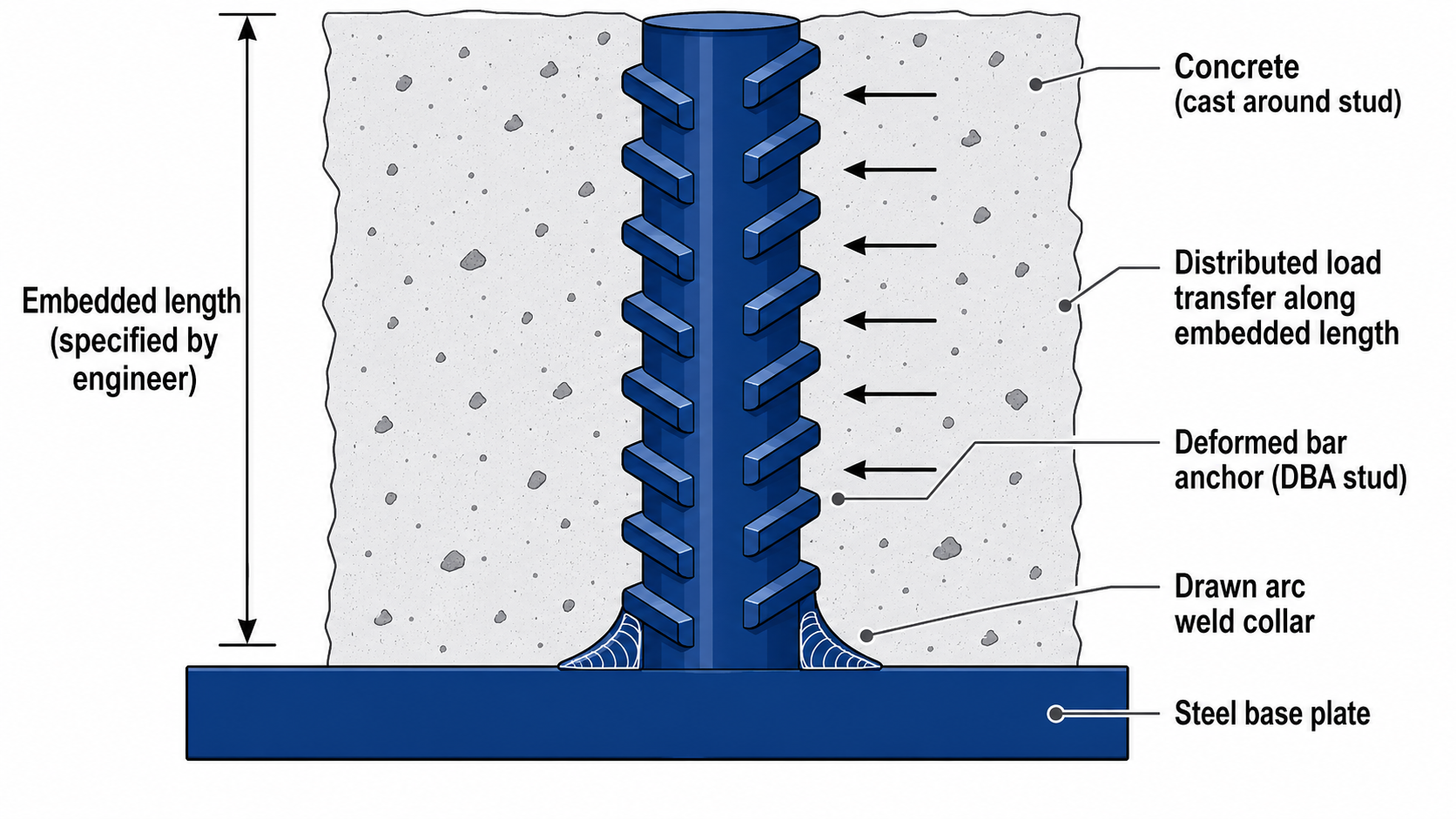
The weld end is a standard drawn arc geometry — flat or slightly pointed tip with an aluminum arc-initiating flux ball. The opposite end has no head plate. The deformation pattern continues to near the embedded tip. After welding and concrete placement, the stud is fully encased and there is no visible fastener on the concrete face.
DBA vs. Headed Concrete Anchor: When to Use Each
Deformed bar anchors and headed concrete anchors are both weld studs for steel-to-concrete connections, but they develop their load capacity through different mechanisms and suit different structural configurations.
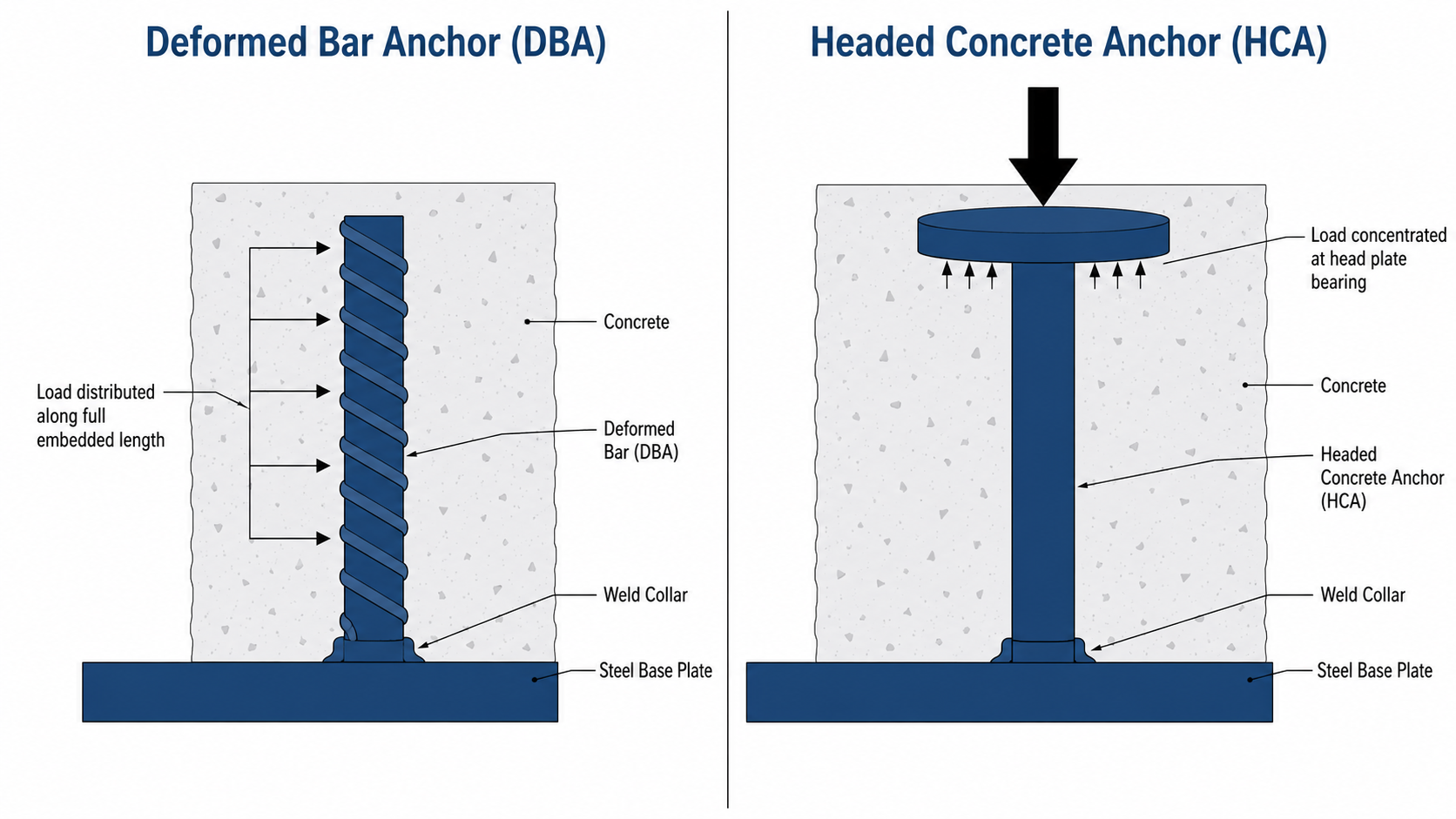
| Property | Deformed Bar Anchor (DBA) | Headed Concrete Anchor (HCA) |
|---|---|---|
| Load transfer mechanism | Surface interlock along embedded length | Bearing on head plate |
| Head geometry | None — smooth or deformed tip | Flat or domed head at tip |
| Primary structural role | Tension, shear via bond in concrete | Shear connector in composite beams; tension anchors |
| Common applications | Precast panels, tilt-up, infrastructure embed plates | Composite steel-concrete floors, bridges, structural columns |
| Welding process | Drawn arc only | Drawn arc only (structural sizes) |
| Code basis | AWS D1.1, project specifications | AWS D1.1, AISC, AASHTO, ACI 318 |
The choice between DBA and HCA is typically driven by project specifications and the structural engineer’s design. HCA is by far the more common product for composite construction. DBA is specified in applications where the distributed bond mechanism along the bar length is structurally advantageous or where project drawings explicitly call for the deformed bar configuration.
Where Deformed Bar Anchors Are Used
Deformed bar anchors appear most frequently in precast and tilt-up concrete construction, and in civil infrastructure applications where the distributed bond of a deformed bar profile is preferred over a concentrated-head bearing mechanism.
- Precast concrete panels — steel embed plates with DBA projections are cast into precast concrete panels during fabrication. The deformed surface bonds into the cast element. After erection, structural connections are made to the projecting plate without drilling into the cured panel.
- Tilt-up construction — tilt-up concrete wall panels use embed plates for crane lift hardware, ledger connections, structural steel frame attachment, and mechanical/electrical penetrations. DBA-equipped embed plates are cast into the slab before tilting.
- Bridge and infrastructure — diaphragm anchors, pier cap connections, and cast-in-place concrete connections in civil work can specify deformed bar anchors when the bond characteristics are appropriate for the loading condition.
- Structural embed plates in poured concrete — columns, grade beams, and foundation elements that require a steel connection face can use DBA embed plates, particularly where the structural design favors a distributed bond over a concentrated head bearing.
Diameter and Length Selection
Diameter and length selection for deformed bar anchors is governed by the structural design, not by a generalized rule. The engineer of record will specify both dimensions based on the required tensile and shear capacity, the concrete compressive strength, embedment depth requirements, and applicable code provisions.
As a practical reference, deformed bar anchors for structural embed plate applications typically range from 1/2" to 7/8" in diameter. Lengths commonly run from 3" to 8" for most precast and tilt-up applications, with longer studs available for deep embed conditions. Embedment depth must account for concrete cover, the required bond length to develop the specified load, and any congestion with reinforcement in the concrete element.
If you are procuring from a drawing, the drawing will specify diameter, length, quantity per plate, and often the project standard the embed is designed to. Bring those dimensions to us and we will confirm the matching stud configuration.
Welding Process
Deformed bar anchors are welded exclusively by the drawn arc process. CD welding is not suitable for the structural diameters (1/2" and up) and base material thicknesses typical of embed plate applications. Drawn arc provides the full-penetration fusion weld required to develop the rated pull-out and shear capacity of the stud-to-plate connection.
Power source requirements follow the same scale as other drawn arc stud types:
- 400 amps for studs up to 7/16" diameter
- 600 amps for 1/2" diameter studs
- Larger-capacity equipment (800A and above) for 5/8" and larger
A ceramic ferrule matched to the stud diameter is required. The ferrule contains the weld pool, forms the weld collar, and prevents atmospheric contamination of the arc zone during welding. See the Weld Stud Ferrule Sizing Chart for matched ferrule dimensions by stud diameter.
Materials
Deformed bar anchors for structural embed plate applications are manufactured from low carbon steel per ASTM A108, the same material standard as headed concrete anchors and shear connectors. This grade provides a consistent chemistry and mechanical property range that is compatible with drawn arc welding parameters and produces predictable weld quality across production runs.
For applications with corrosion exposure — coastal precast panels, infrastructure in deicing-salt environments, or any embed plate that will see persistent moisture before or after concrete placement — stainless steel options are available. Contact our team to confirm availability for your required diameter and length.
Codes and Standards
Structural applications of deformed bar anchors are governed by the following standards:
- ASTM A108 — material standard for the cold-finished carbon steel bar stock used in stud manufacture. Specifies chemical composition and mechanical properties.
- AWS D1.1 Structural Welding Code — Steel — governs drawn arc stud welding procedures, operator qualification, and inspection requirements. Applicable to any structural weld stud installation on steel base metal.
- ACI 318 — the concrete design code. The concrete-side capacity of an embedded anchor (tension breakout, shear, pryout) is designed per ACI 318 Chapter 17 anchorage provisions, regardless of whether the anchor is HCA or DBA.
- Project specifications — precast and tilt-up projects will typically have project-specific requirements for stud material, welding procedure, inspection, and acceptance criteria that supplement or reference the above standards.
Installation Notes
Deformed bar anchor installation follows drawn arc stud welding practice with a few considerations specific to embed plate applications:
- Plate flatness and cleanliness — the embed plate must be flat at the weld locations and free of mill scale, rust, and coatings in the weld area. Warped plates or surface contamination produce inconsistent weld collars. Straighten plates before welding if needed; grind weld areas to bare steel.
- Stud spacing and edge distance — minimum stud-to-stud and stud-to-plate-edge distances are specified by the structural engineer and depend on the plate thickness and loading. Follow the project drawings; do not crowd studs at plate edges without engineering confirmation.
- Ferrule retention — after welding, remove the ceramic ferrule by striking or twisting (ferrules are single-use and break off cleanly after the weld cools). Inspect the weld collar: it should be full, symmetrical, and free of cracks. A standard 30° bend test on a sample confirms fusion integrity.
- Embed placement in formwork — embed plates with welded DBA studs are positioned in formwork using wire ties to reinforcing, magnetic holders, or formed pockets. The stud projections must be oriented to embed into the pour. Concrete vibration should not disturb plate position; check position after vibration and before pour sets.
Frequently Asked Questions
What is a deformed bar anchor and how is it different from regular rebar?
A deformed bar anchor is a weld stud — it has a weld end designed for drawn arc stud welding to a steel base plate. Rebar is continuous reinforcing bar that is tied into concrete reinforcement cages, not welded to steel plates. They share a similar surface deformation profile, but their application, dimensions, and welding suitability are completely different. Rebar should not be used as a substitute for deformed bar anchors in weld stud applications.
When would I use a deformed bar anchor instead of a headed concrete anchor?
The structural engineer of record makes this determination based on the design loads, embedment conditions, and applicable code provisions. As a general guide, HCA is the dominant choice for composite construction (steel beams with concrete slabs) because its shear capacity is well-established in AISC and AASHTO design procedures. DBA is specified in precast and tilt-up applications where the distributed bond mechanism along the bar is preferred, or when the project specifies the deformed bar configuration explicitly. If you’re unsure which to order, the project drawings or specifications will tell you.
Can deformed bar anchors be welded with CD welding equipment?
No. Deformed bar anchors are structural products used in diameters (1/2" and above) that require the drawn arc process for full-penetration fusion. CD welding equipment cannot produce the weld energy needed at those diameters, and the base materials in embed plate applications are typically too thick for CD process anyway. Always use drawn arc equipment with the correct power source for the stud diameter.
What is the required embedment depth for deformed bar anchors?
Required embedment depth is determined by the structural design, not by a standard rule. It depends on the concrete compressive strength, the stud diameter, the applied loads, and the applicable code (typically ACI 318 for the concrete-side capacity). The engineer of record specifies embedment depth on the project drawings. The stud length you order must provide sufficient embedment plus any standoff above the plate face.
Do deformed bar anchors require a ferrule?
Yes. Deformed bar anchors use the drawn arc welding process, which requires a ceramic ferrule matched to the stud diameter. The ferrule contains the weld pool during the arc cycle and forms the weld collar. It is broken off after the weld cools and is not reusable. See our Weld Stud Ferrule Sizing Chart for matched ferrule sizes by stud diameter.
Related Resources
- Weld Stud Selection Guide — full cluster overview covering all stud types, process selection, and material options
- Headed Concrete Anchors & Shear Connectors Selection Guide — HCA and shear connector selection for composite construction
- Threaded Weld Studs Selection Guide — pitch diameter, full thread, and collar stud selection
- Weld Stud Ferrule Sizing Chart — matched ferrule sizes for every drawn arc stud diameter
- Shop All Weld Studs